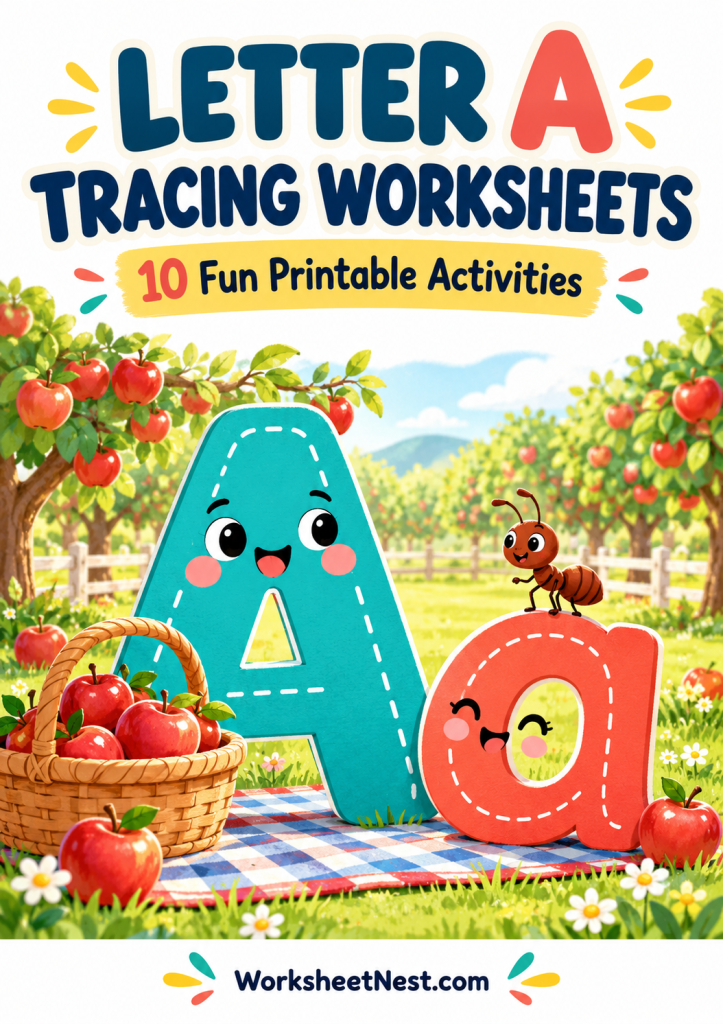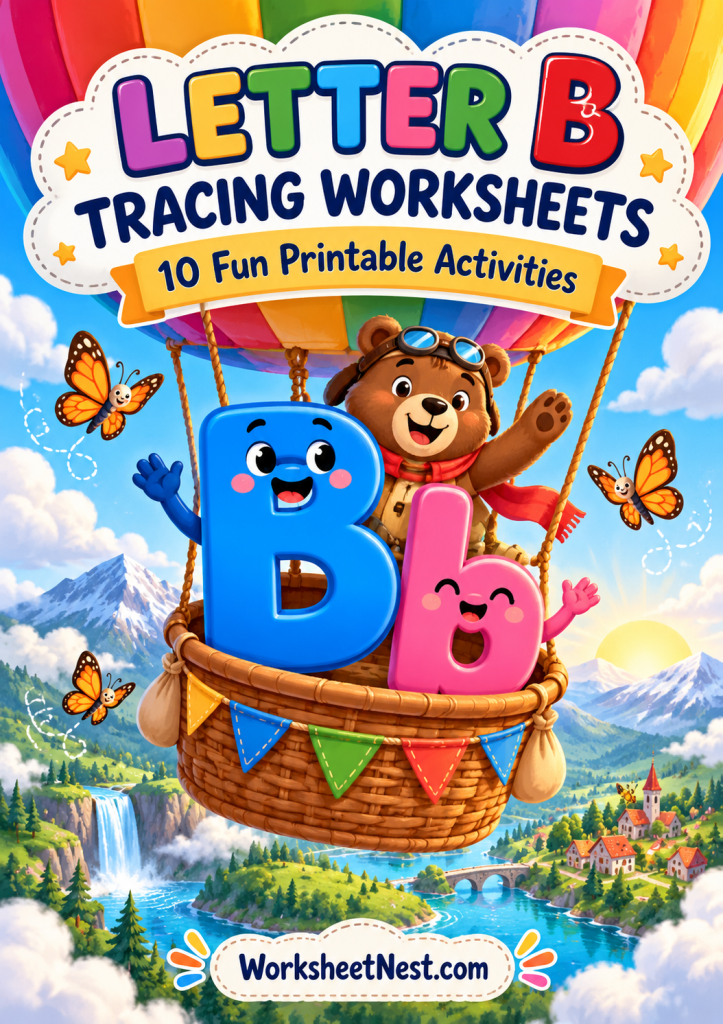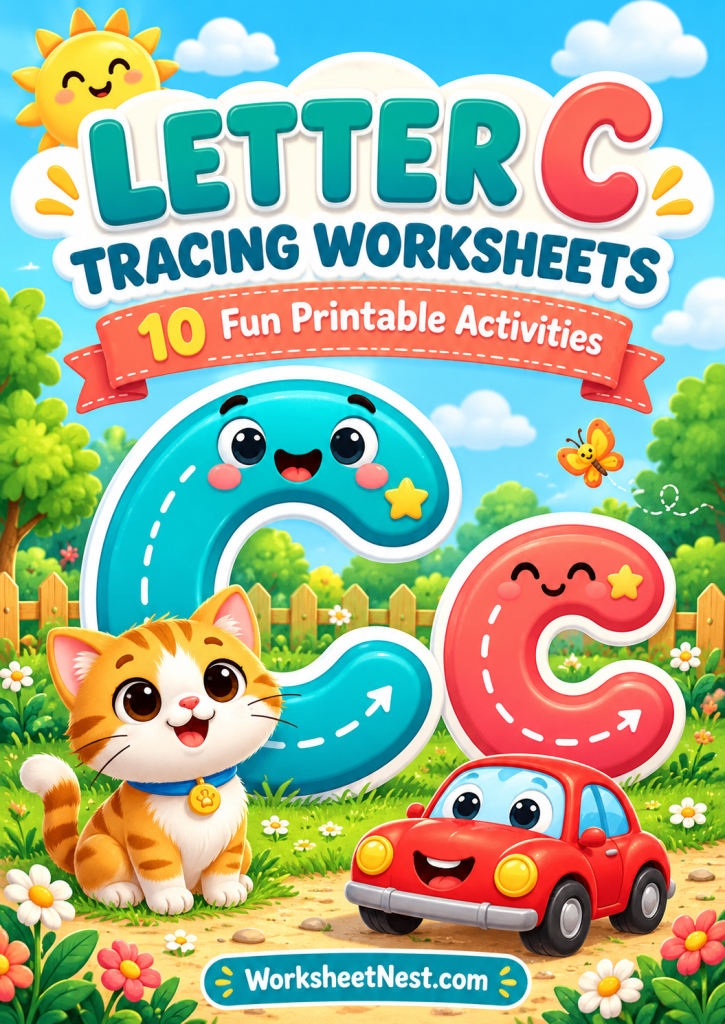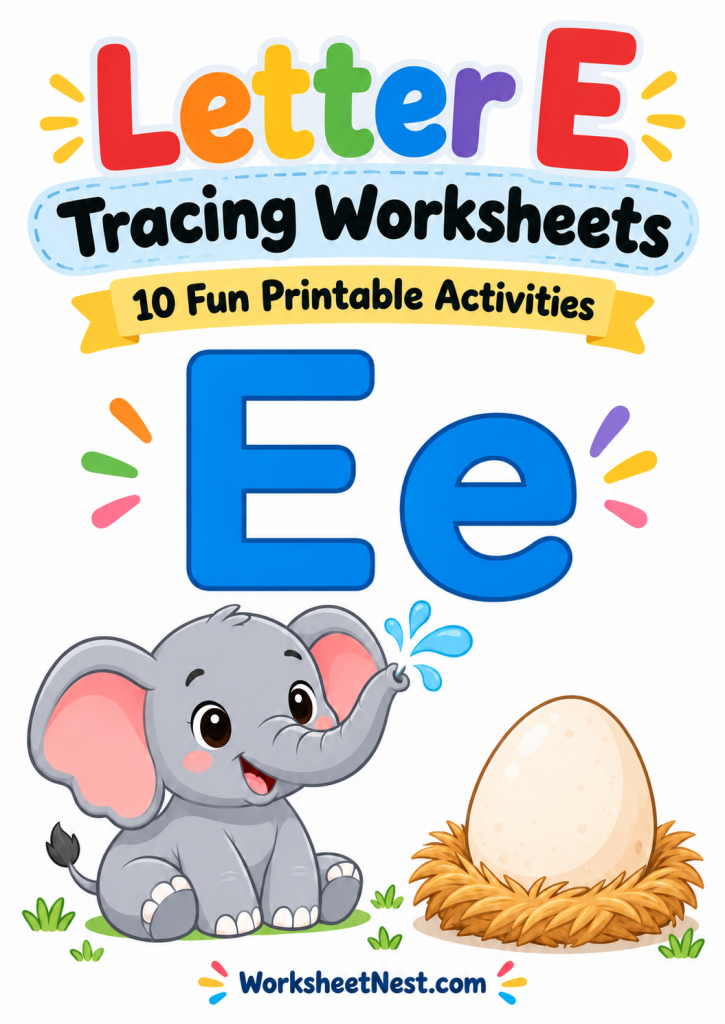
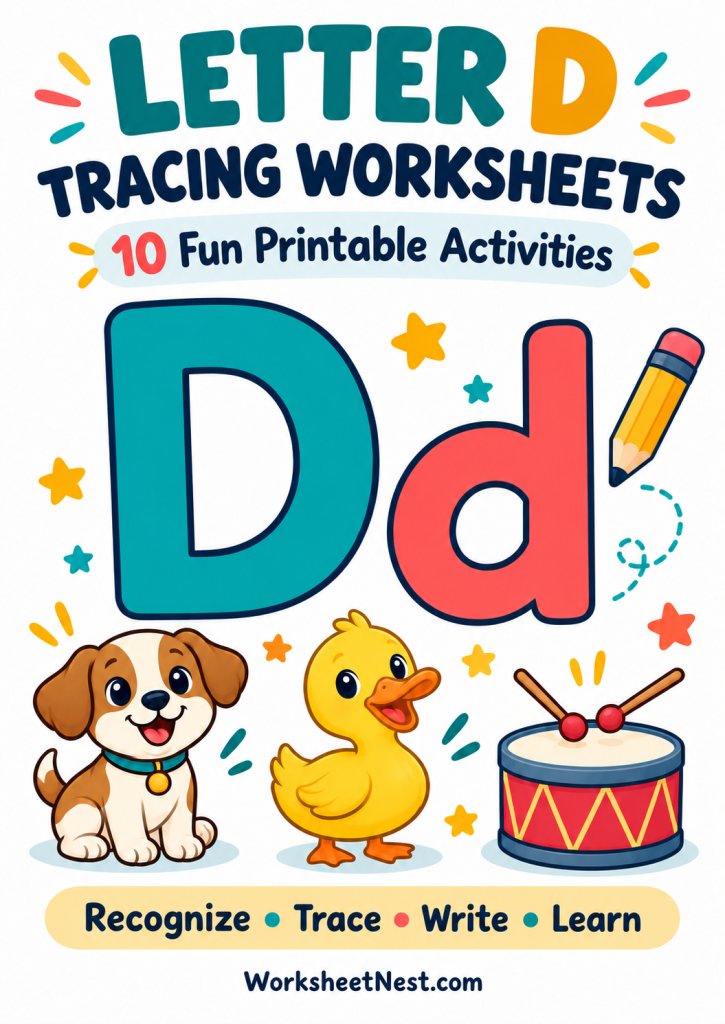
Meet uppercase D and lowercase d through coloring, finding, tracing, matching, and writing. These letter D tracing worksheets offer ten different practice pages, with a colorful cover to introduce the collection. Dog, duck, and drum provide familiar picture words to talk about as children work.
Choose a page that matches what your learner is ready to try. A child who recognizes D may still need help spotting d or placing its tall line on the correct side. The separate recognition and writing pages let you practice one skill at a time before bringing the skills together.
Choose a Letter to Practice
Worksheet 1: Color D and d; dog and duck
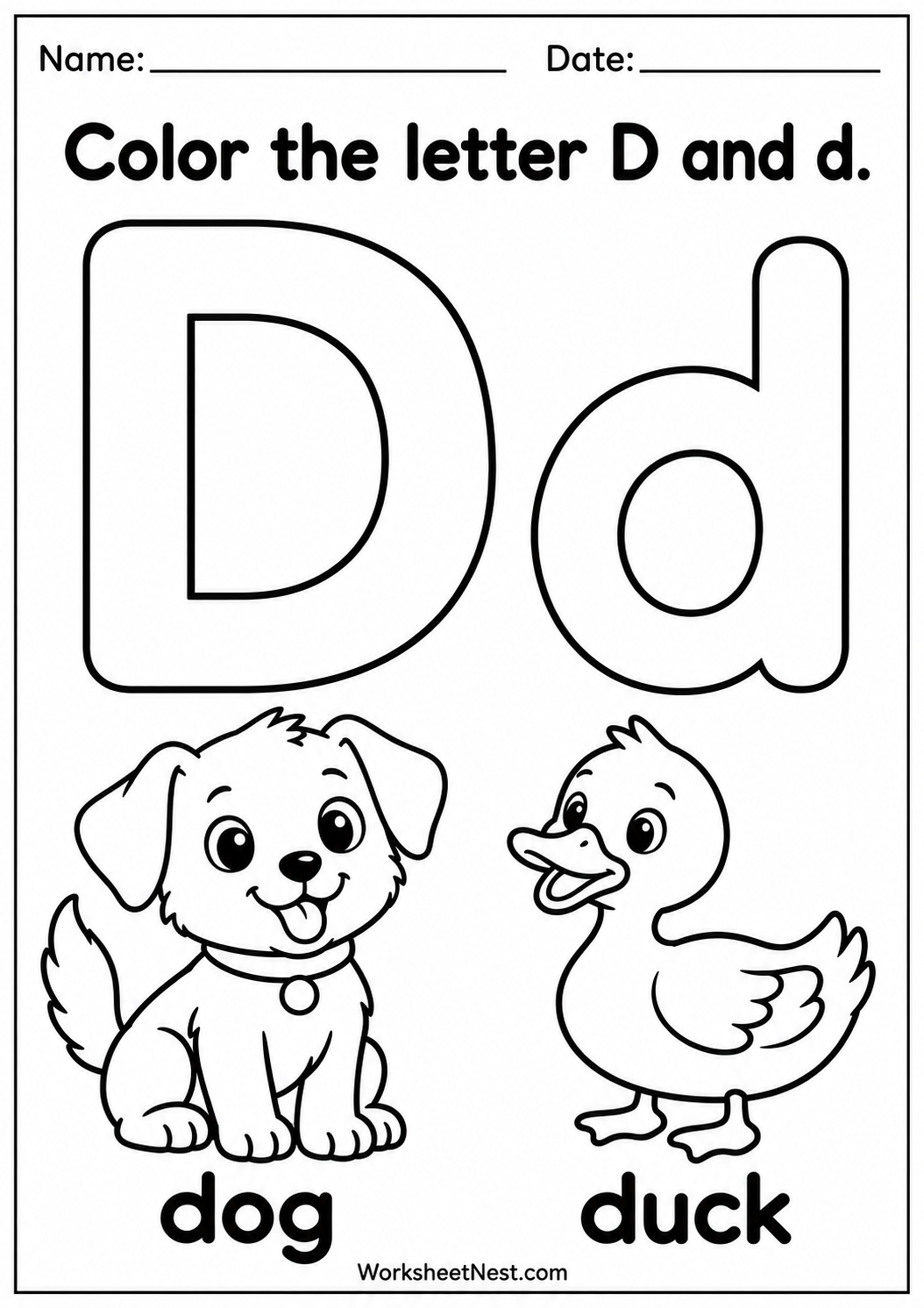
Children color two large outline letters and pictures of a dog and a duck. Before coloring, ask them to point to the capital letter and then the small letter. Say each picture name together and listen for the sound at the beginning. This page introduces the shapes without requiring pencil tracing.
Worksheet 2: Find uppercase D and trace
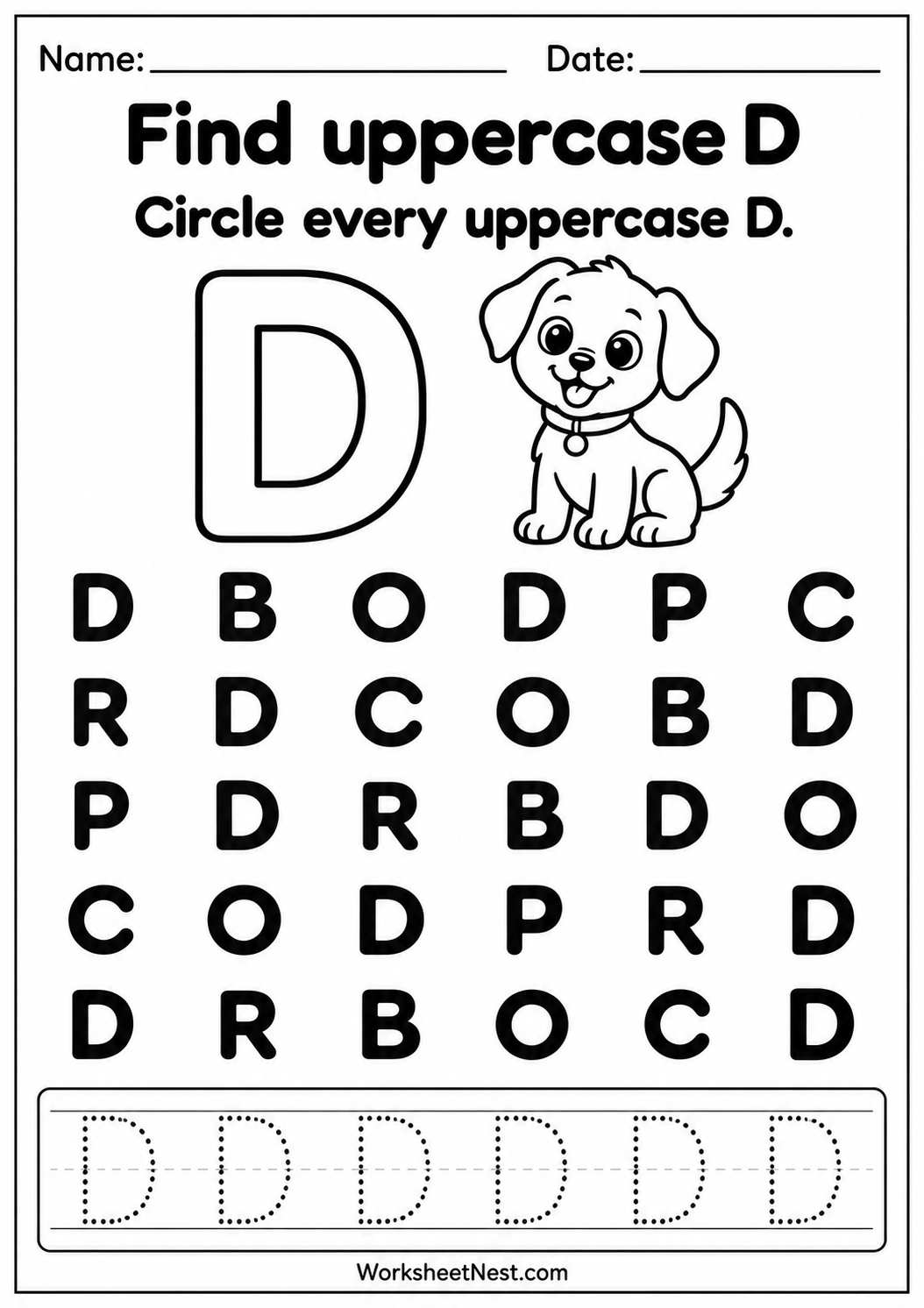
Find capital D among other uppercase letters, then practice the dotted letters along the bottom. Encourage children to look at one row at a time instead of guessing from the whole page. The straight side and rounded side give them two details to check when comparing D with nearby letters.
Worksheet 3: Find lowercase d and trace
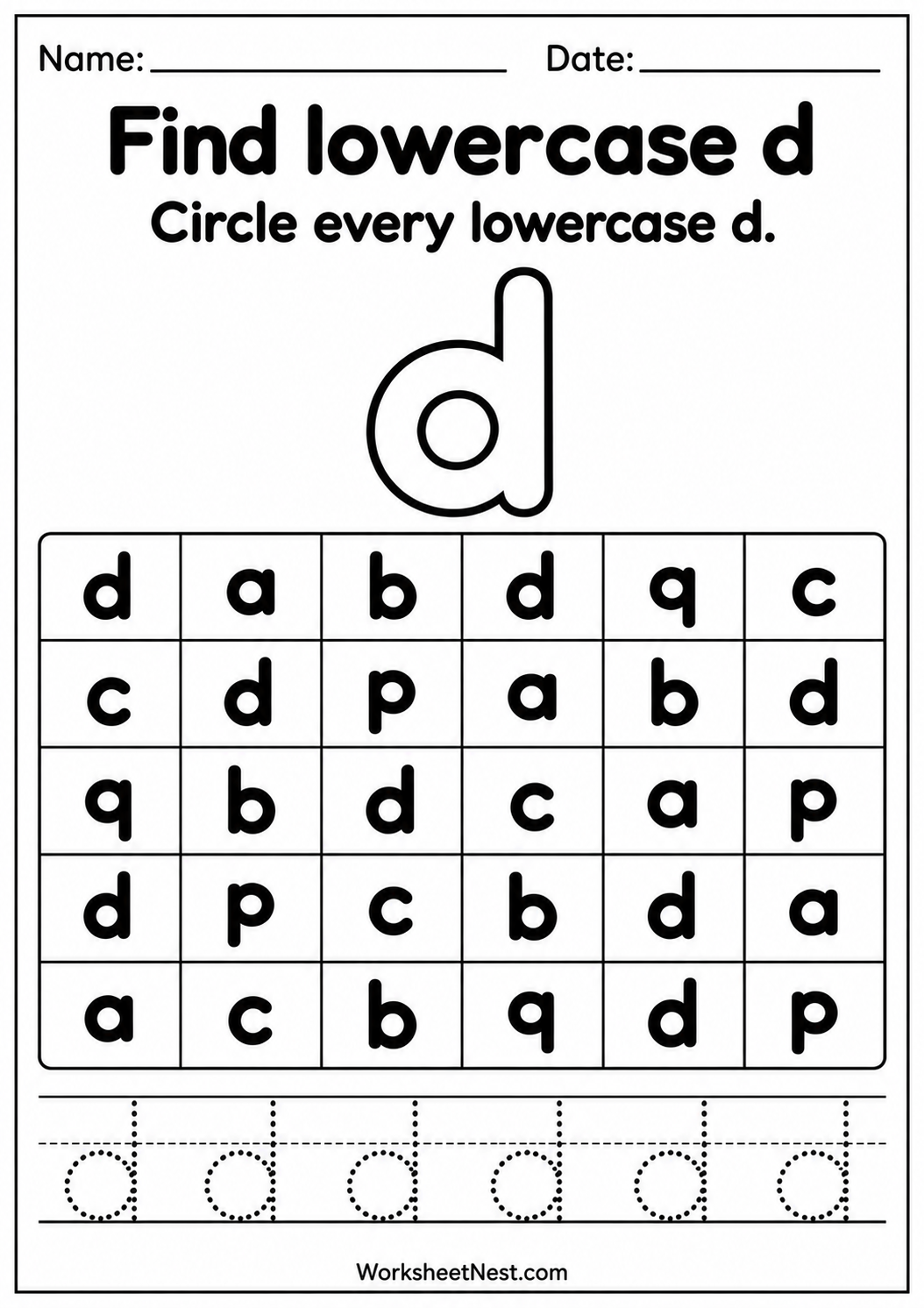
This page asks children to spot d in a grid containing other lowercase letters. Look carefully at the round part and the tall line before circling a choice. A tracing row below the grid connects recognition with writing. If a child confuses b and d, compare the two shapes slowly beside the model.
Worksheet 4: Trace and independently write D
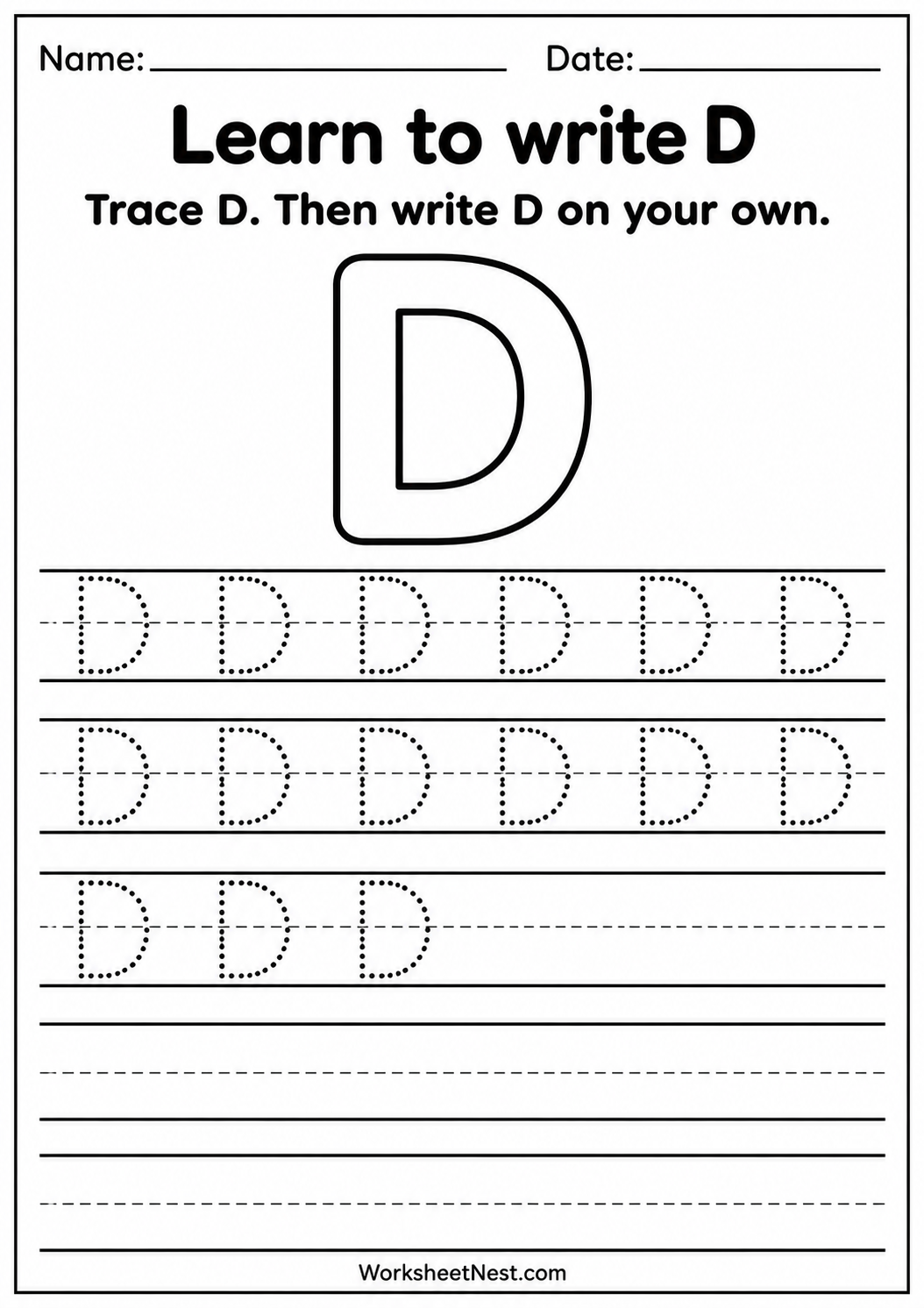
A large capital model introduces rows of dotted D letters. Later rows leave room for children to write with less support. Demonstrate one letter, then let the learner try a short section. Use the writing guides to discuss where the letter starts and how high it reaches.
Worksheet 5: Trace and independently write d
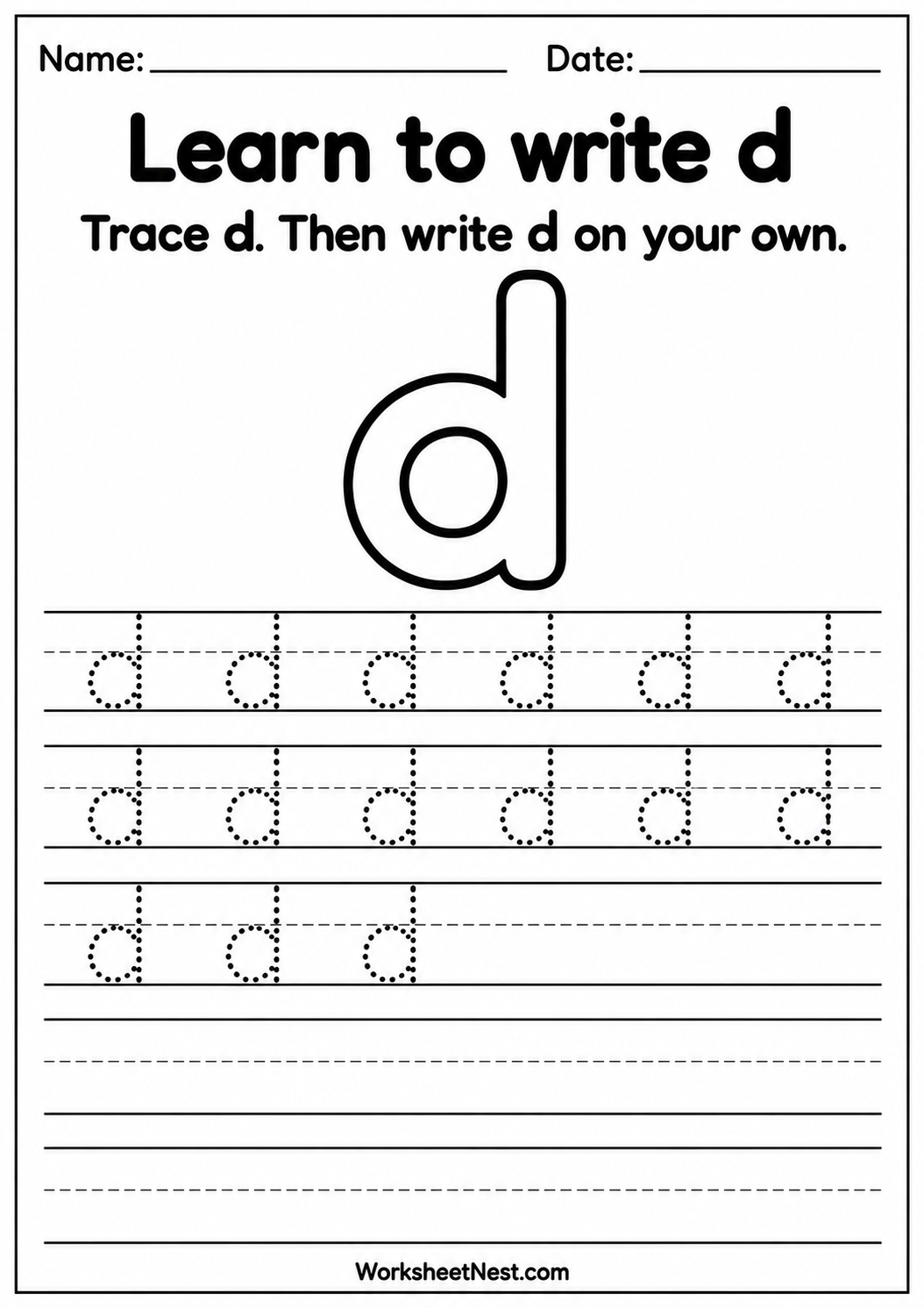
Practice lowercase d with a large model, dotted letters, and open writing space. Draw attention to the small rounded part and its tall line on the right. Children can trace a model with a finger before using a pencil. Return to one clear example whenever the shape becomes uncertain.
Worksheet 6: Trace uppercase D and lowercase d
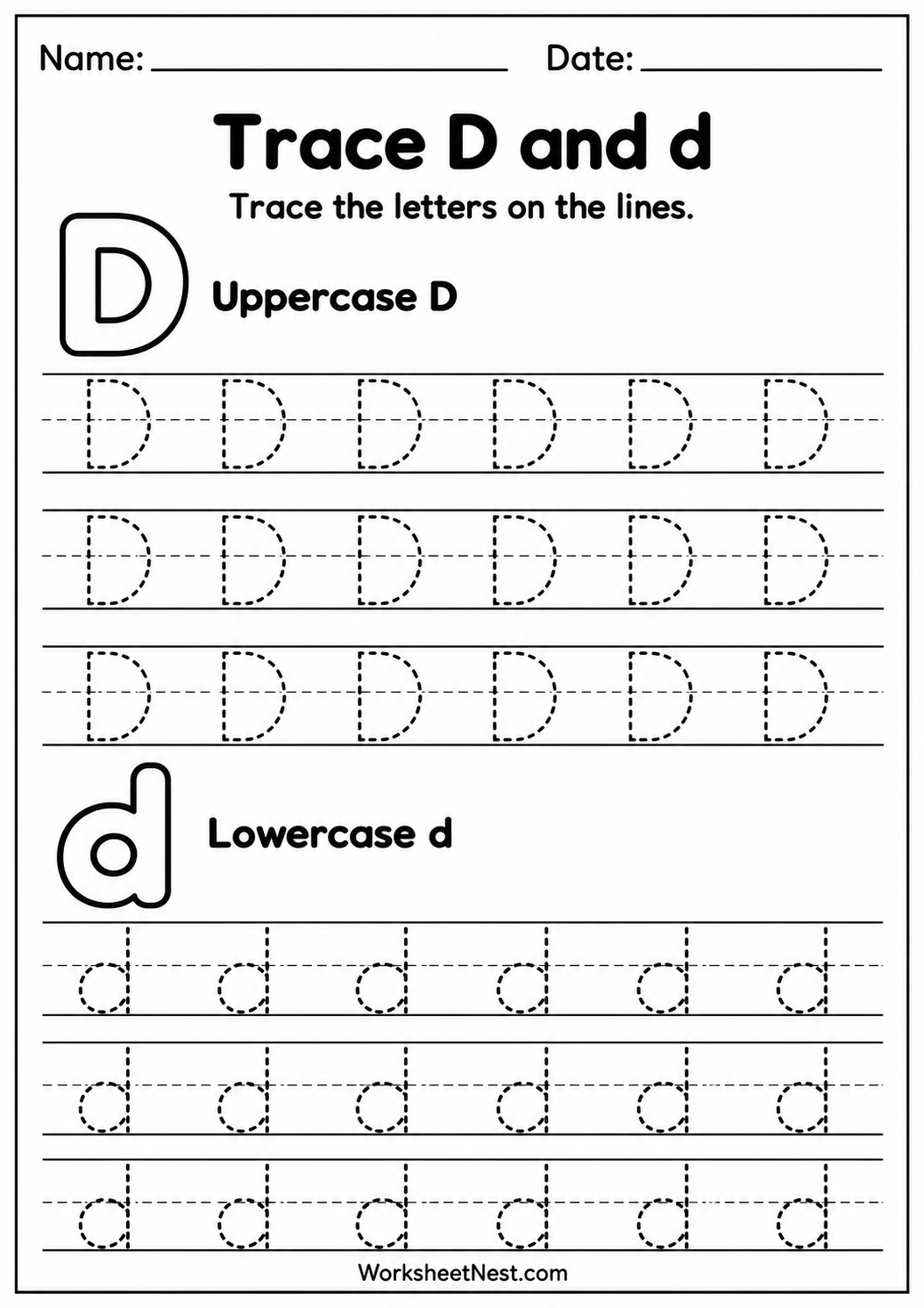
Uppercase and lowercase practice appear in separate sections on the same page. Children trace both forms on handwriting guides, noticing that the capital fills the writing height while the small letter has a rounded body and a tall line. Work through a few letters carefully rather than rushing to finish every row.
Worksheet 7: Match D/B/C/A to lowercase partners
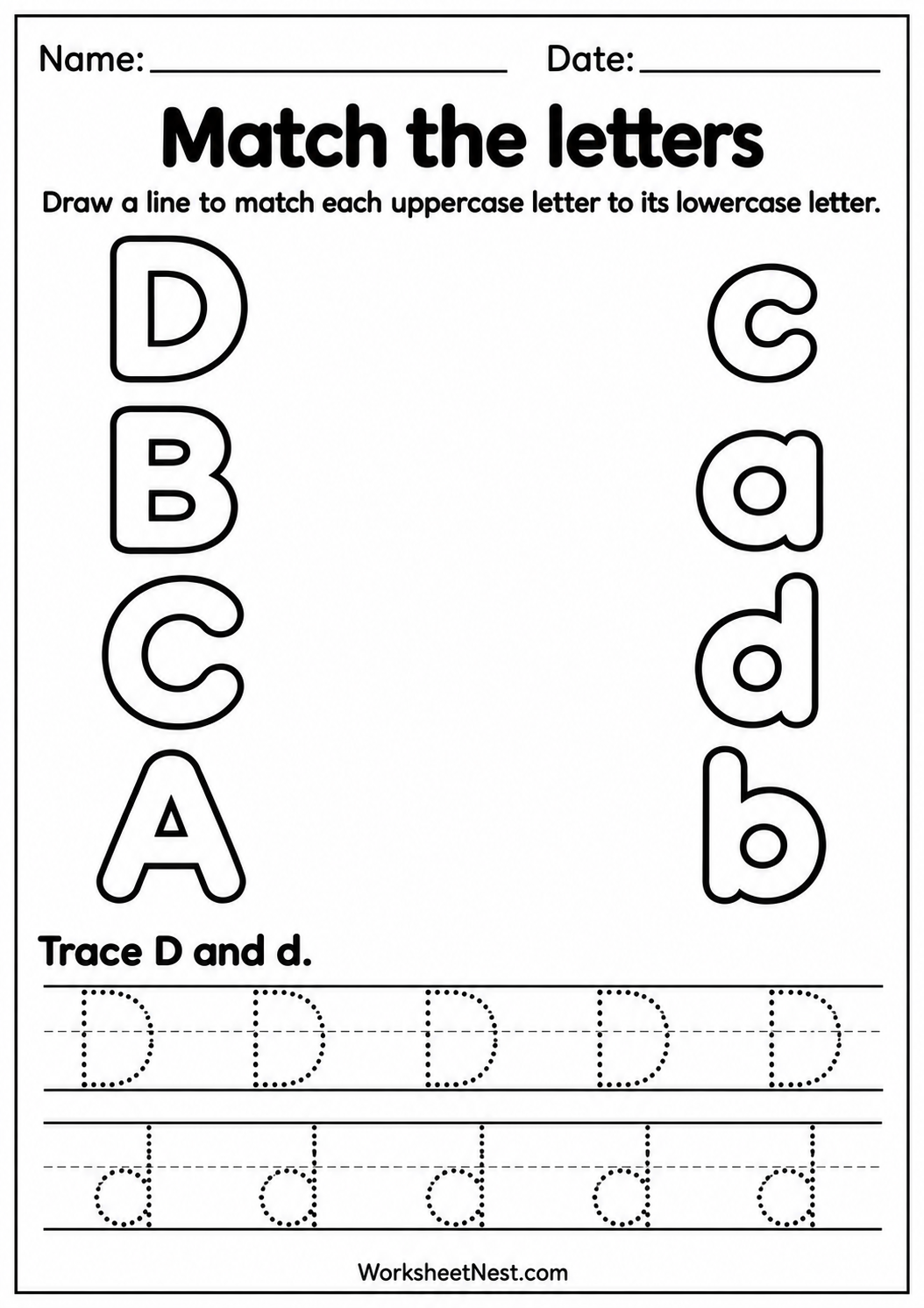
Connect uppercase D, B, C, and A with their lowercase partners in a mixed order. The activity checks case matching, so children need to look beyond letters placed directly opposite one another. Two tracing rows below the matching task return the focus to D and d.
Worksheet 8: Trace and write dog, duck, drum
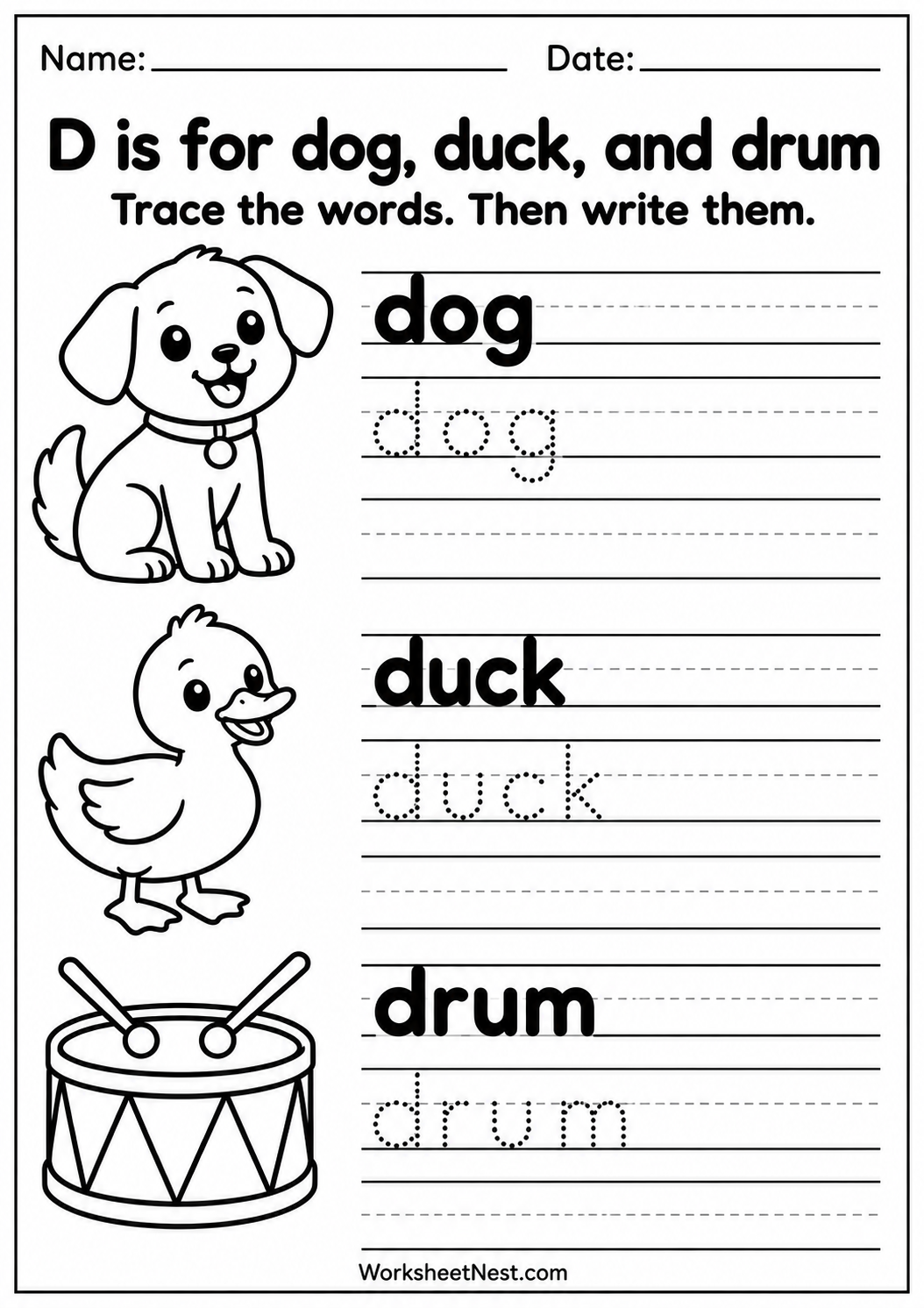
Three picture sections pair dog, duck, and drum with word models, tracing, and writing space. Name each object before reading its word together. Invite the child to find the first d in each word, then trace. A beginner can focus on that first letter while an adult helps with the remaining letters.
Worksheet 9: Independently write D and d
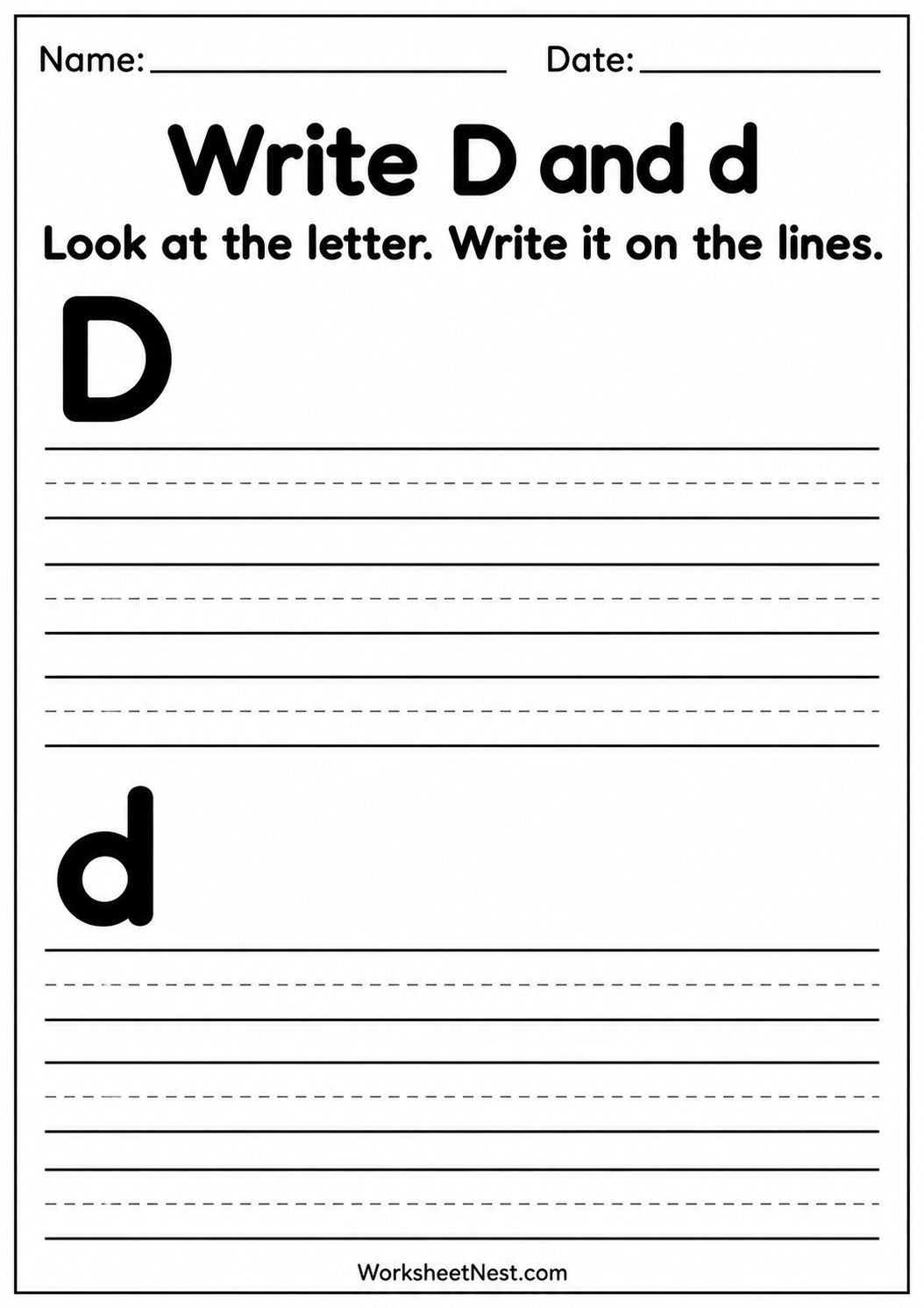
Small models introduce separate areas for independent capital and lowercase writing. The lines are left open so children can make their own letters. Ask for a few thoughtful attempts, then compare one with the model. Praise a specific detail, such as a clear curve or a tall line in the correct place.
Worksheet 10: Recognition, tracing, writing and initial-sound review
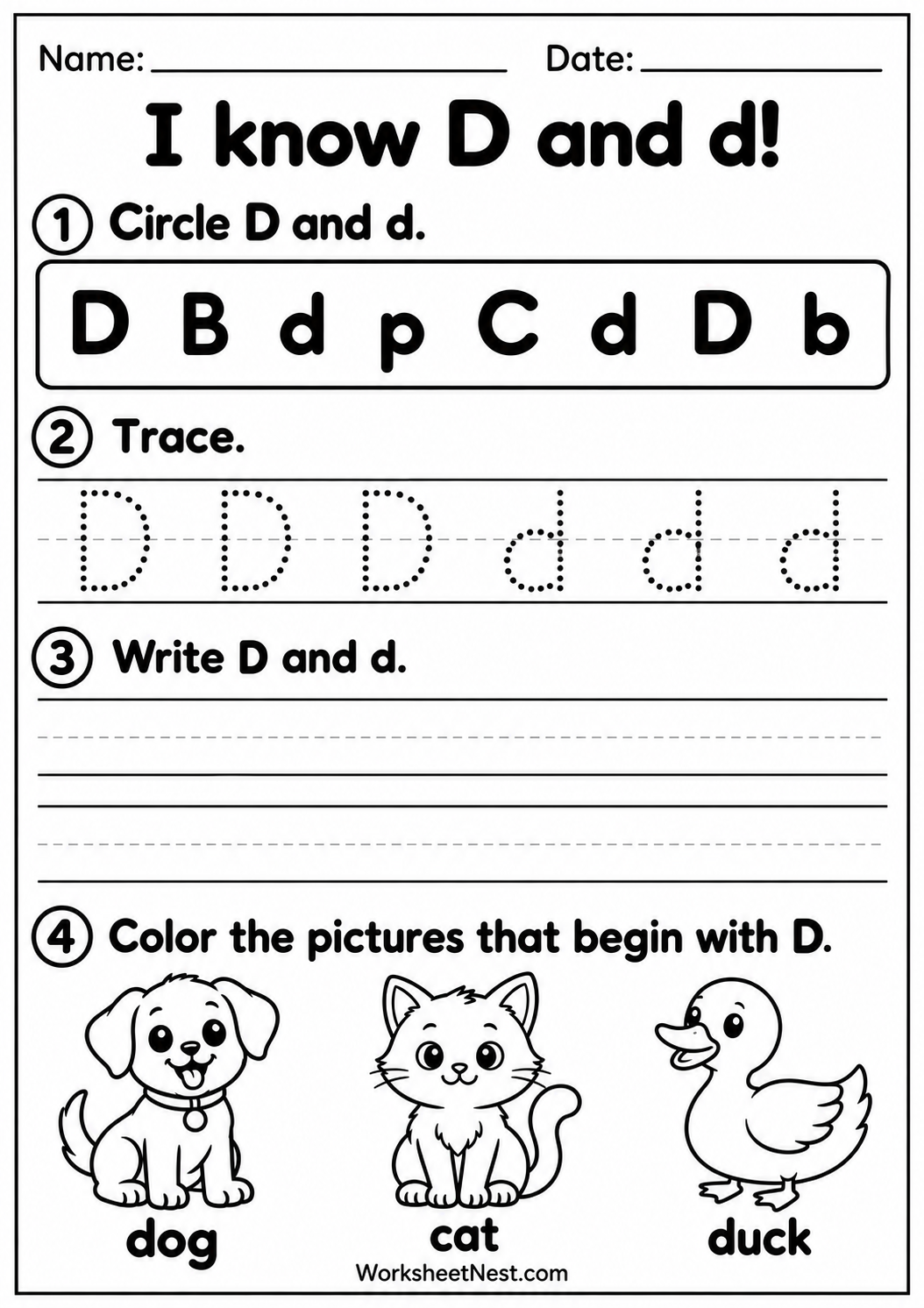
The review combines finding letters, tracing, independent writing, and choosing pictures that begin with D. Dog and duck appear alongside a cat, giving children a reason to say each name and listen. Use the page to notice which skill needs another short practice session.
The Full Letter D Bundle
The bundle contains one colorful cover and ten black-and-white activity pages. Use the whole sequence over several sessions, or select an individual activity for a small group or home practice. Recognition, supported writing, and independent writing each have their own place in the collection.
Teaching Guidance for Letter D Tracing Worksheets
Start with a spoken picture name and a clear letter model. Keep practice brief enough that children can control their pencil comfortably. If they tire, pause and return later. When a lowercase d is reversed, place a correct model beside the attempt and compare where the tall line belongs.
Before children read, they build pre-reading skills such as alphabet knowledge and print awareness, as described in Colorín Colorado’s Reading in Kindergarten.
Printing and Use
Preview the PDF before printing and check that borders, writing guides, and the website footer remain visible. Print one test page before making classroom copies. Keep the cover separate when you only need the black-and-white activities. Use the terms supplied with the resource to check permitted copying and sharing.
Common Core Connections
These activities give focused practice with selected parts of the kindergarten skills below. They do not cover every part of these skills.
RF.K.1.d: Recognize and name all upper- and lowercase letters of the alphabet — Practiced in: Worksheet 1: Color D and d; dog and duck, Worksheet 2: Find uppercase D and trace, Worksheet 3: Find lowercase d and trace, Worksheet 7: Match D/B/C/A to lowercase partners, and Worksheet 10: Recognition, tracing, writing and initial-sound review, which support recognition and naming.
L.K.1.a: Print many upper- and lowercase letters — Practiced in: Worksheet 4: Trace and independently write D, Worksheet 5: Trace and independently write d, Worksheet 6: Trace uppercase D and lowercase d, and Worksheet 9: Independently write D and d, which support printing.
Worksheet 8: Trace and write dog, duck, drum is not mapped to either skill above, because it traces whole words rather than single letters.
For preschool, use these pages as general practice in recognizing and printing D and d.
Related Practice
Return to a recognition page when finding the letter is difficult, or revisit a tracing page before trying independent writing again. Choose the next alphabet activity according to the child’s progress rather than completing pages only to finish a bundle.
License and Terms of Use
Free for personal, homeschool, and classroom use; do not sell, re-upload, or redistribute.