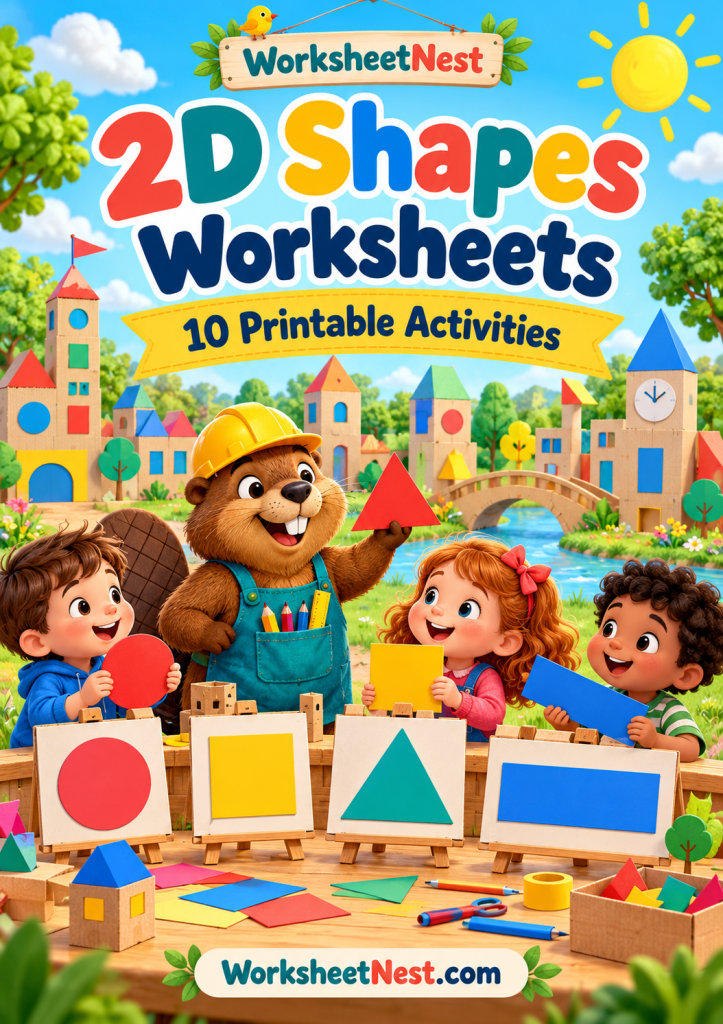
Introduce circles, squares, triangles, and rectangles with these 2D shapes worksheets. The collection includes ten black-and-white activity pages and a separate colorful cover. Children trace and match outlines, find shapes, compare everyday objects, count sides and corners, draw their own shapes, and follow a circle path.
Choose a page that fits the learner’s current confidence. Preschool children may begin with naming, matching, or a supported tracing row, while kindergarten learners can try property-counting and review tasks. An adult can read directions and invite children to explain their choices aloud. The pages use four basic flat shapes; the pictured everyday objects are explored through their outside outlines.
01. Trace the Shapes
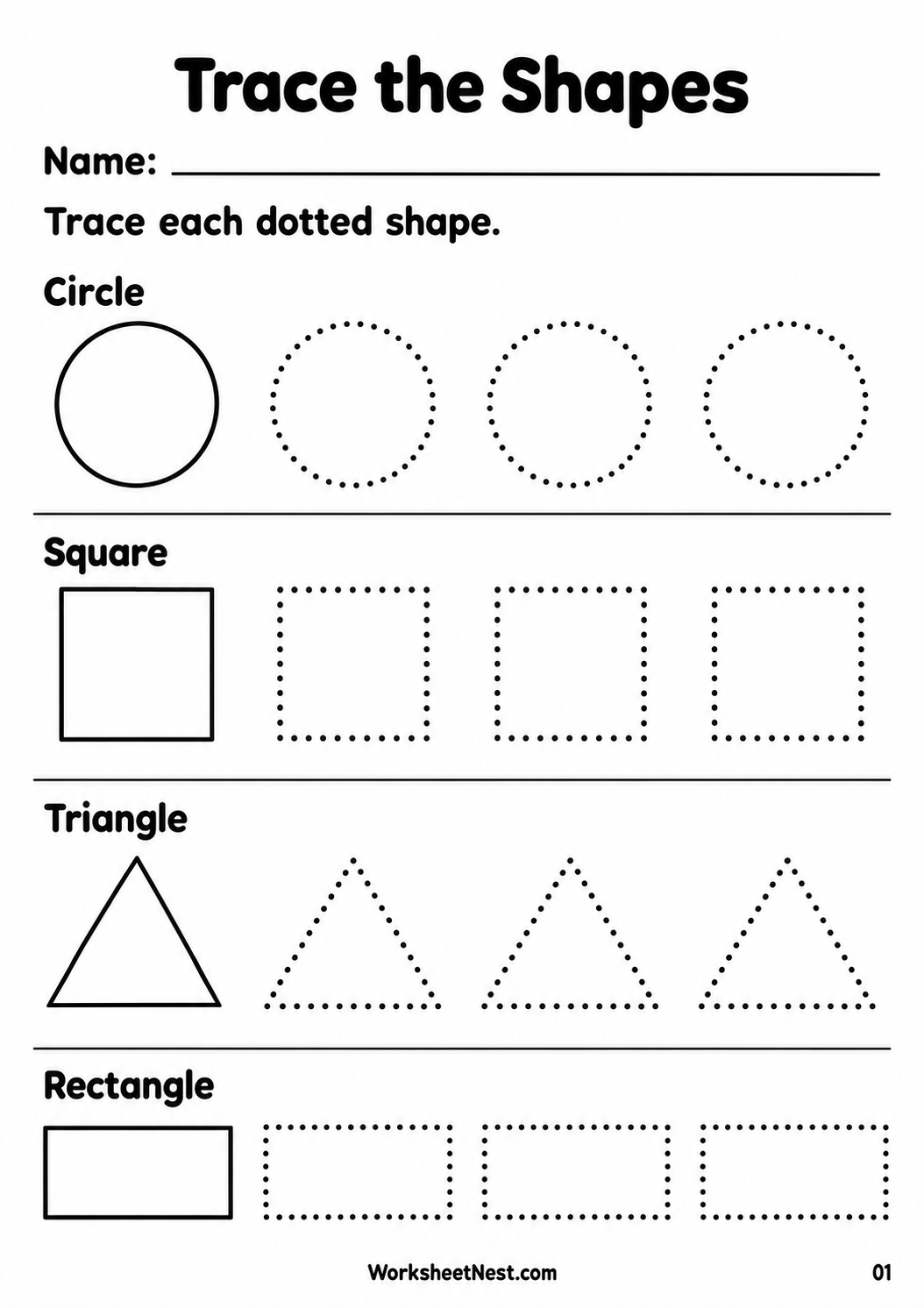
Four rows introduce circles, squares, triangles, and rectangles. Each row starts with a solid example followed by three dotted outlines to trace. Children can name the shape while following its edge. Encourage a slow movement around the whole outline rather than rushing to finish every row, and offer a short break when pencil control becomes tiring.
02. Match the Shapes
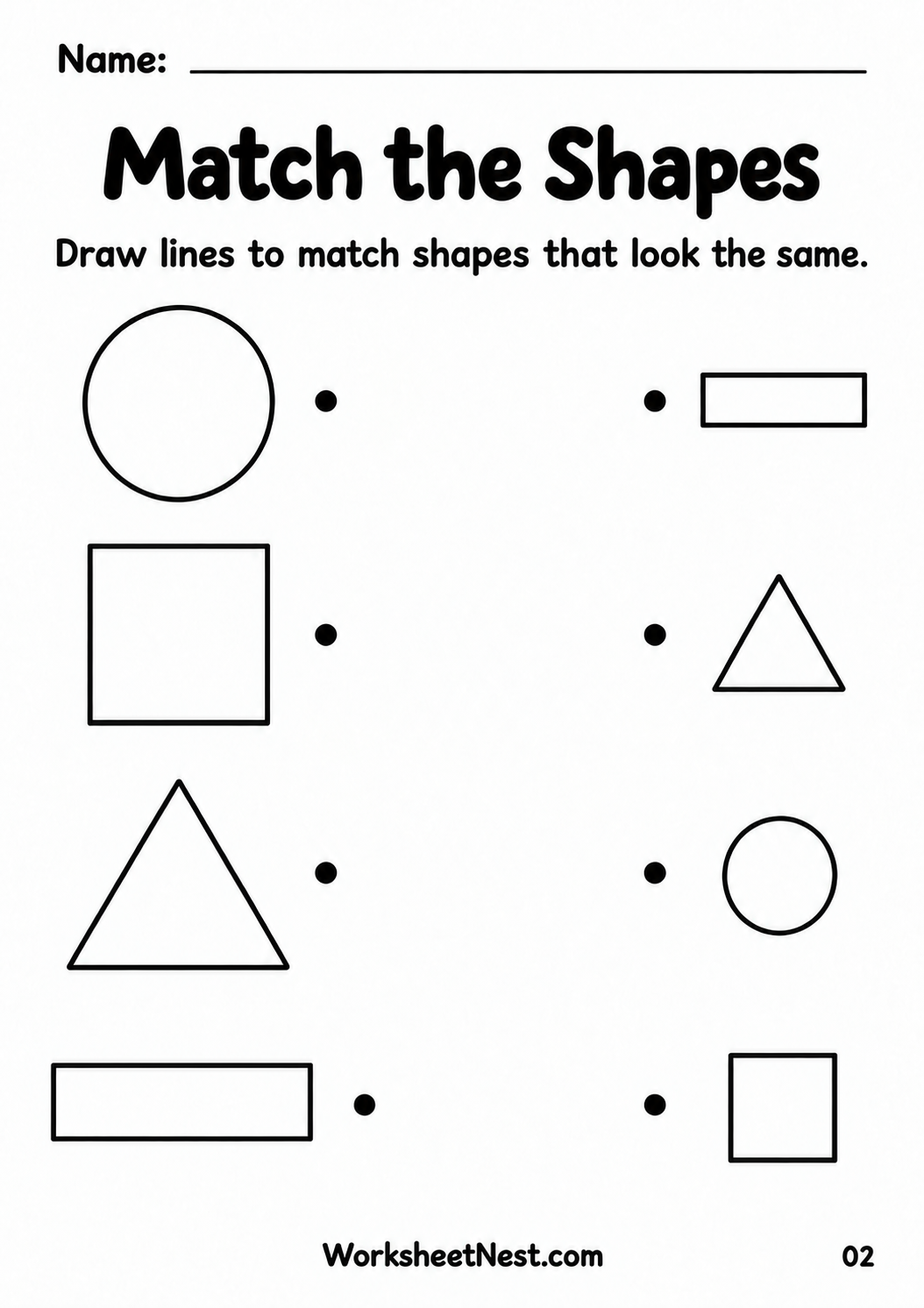
Children draw lines between large shapes on the left and smaller matching outlines on the right. The choices are arranged in a different order, so the learner must compare the outlines rather than connect straight across. The current version preserves the proportions of the long rectangles. Ask children to describe which features stay the same when the shape is smaller.
03. Find the Circles
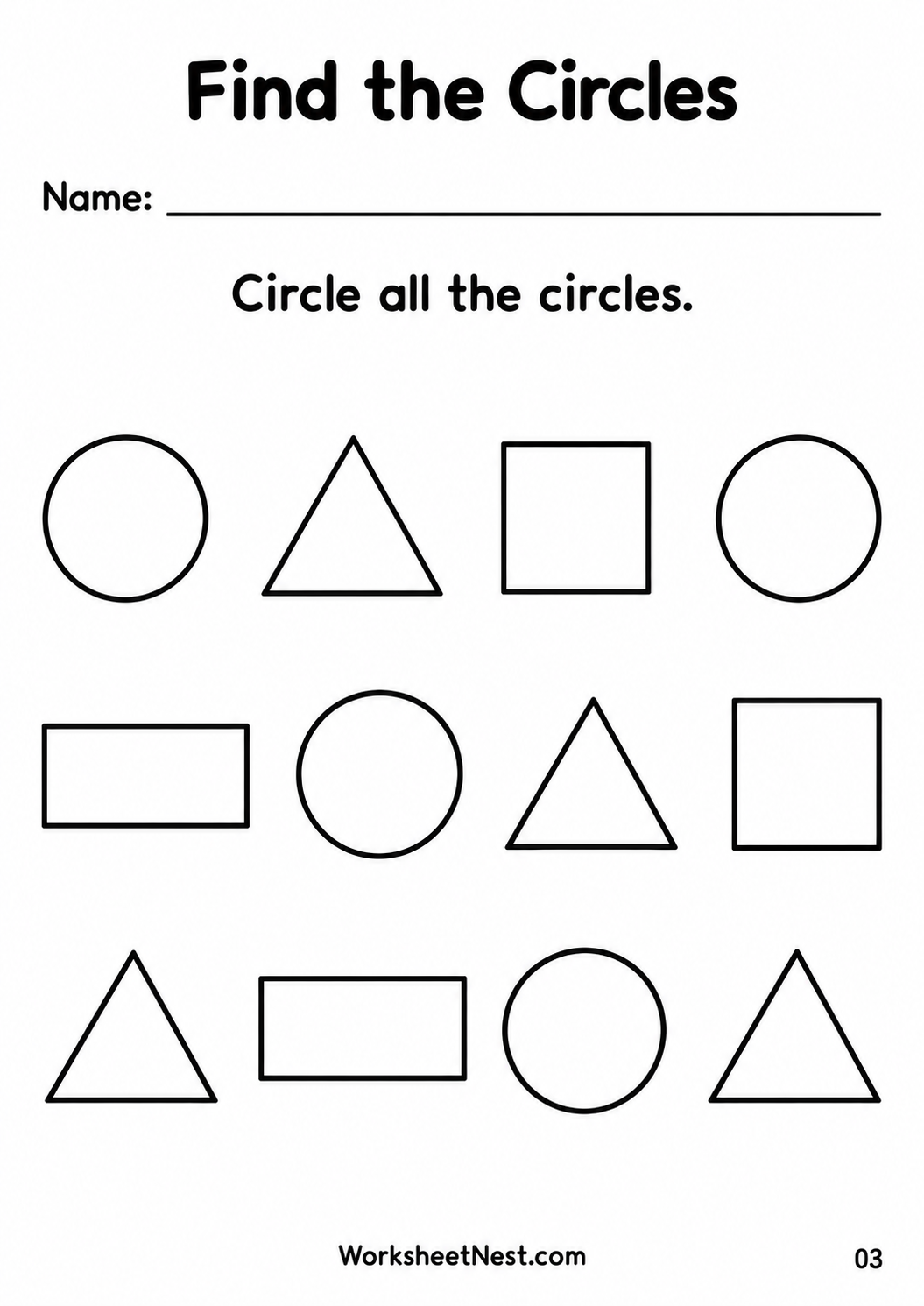
Twelve mixed shapes are arranged in three rows, with four circles to find. Learners circle every circle while leaving the squares, triangles, and long rectangles unmarked. Work across one row at a time to keep the search organized. Invite the child to explain how the curved outline differs from shapes with straight sides and corners.
04. Shapes Around Us
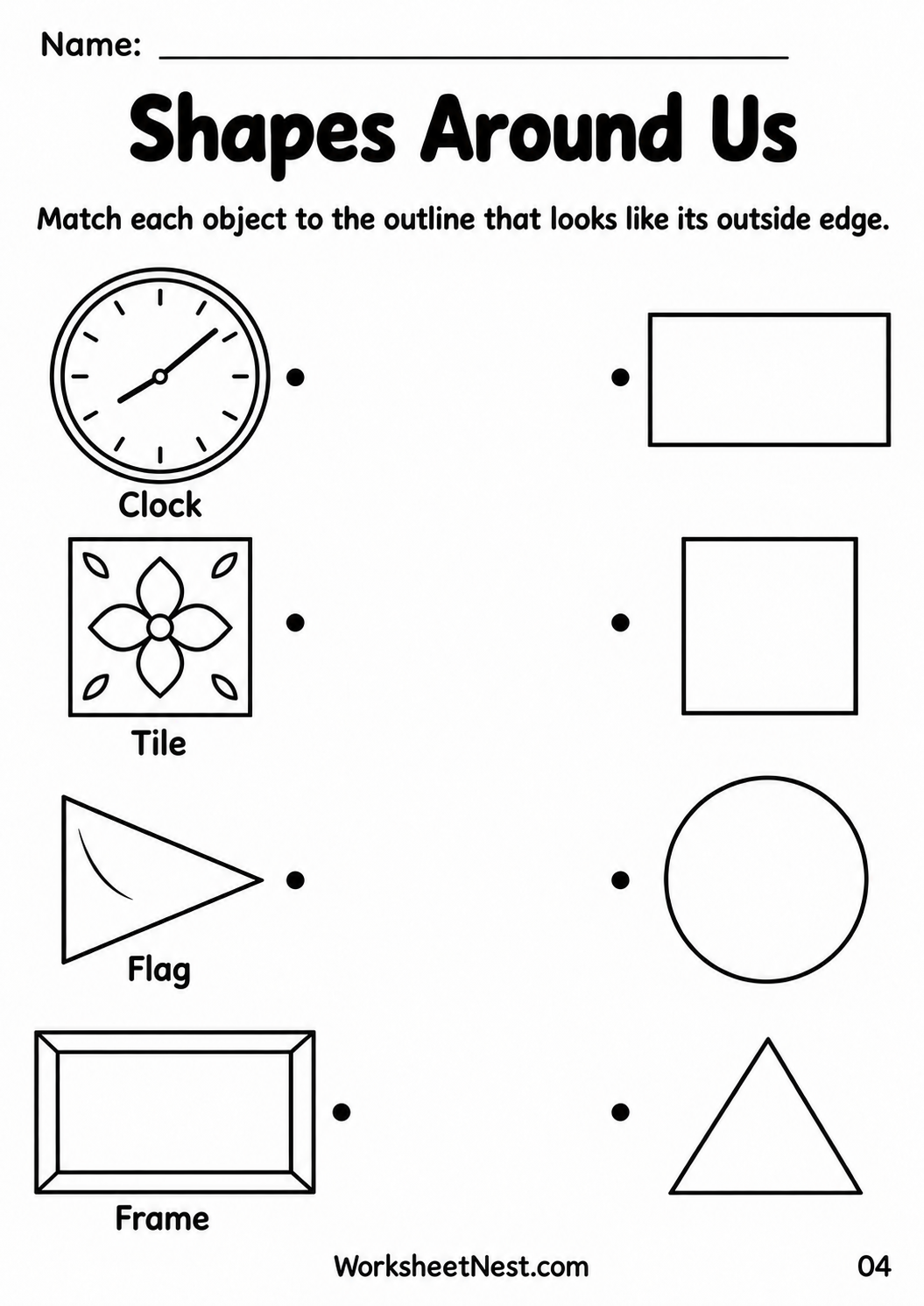
A clock, tile, flag, and frame are matched to basic shape outlines. The instruction focuses on the outside edge of each pictured object, so decorative details inside the tile or clock are not the features being matched. Name the object together, then follow its outer boundary with a finger before choosing the outline.
05. Sort the Shapes
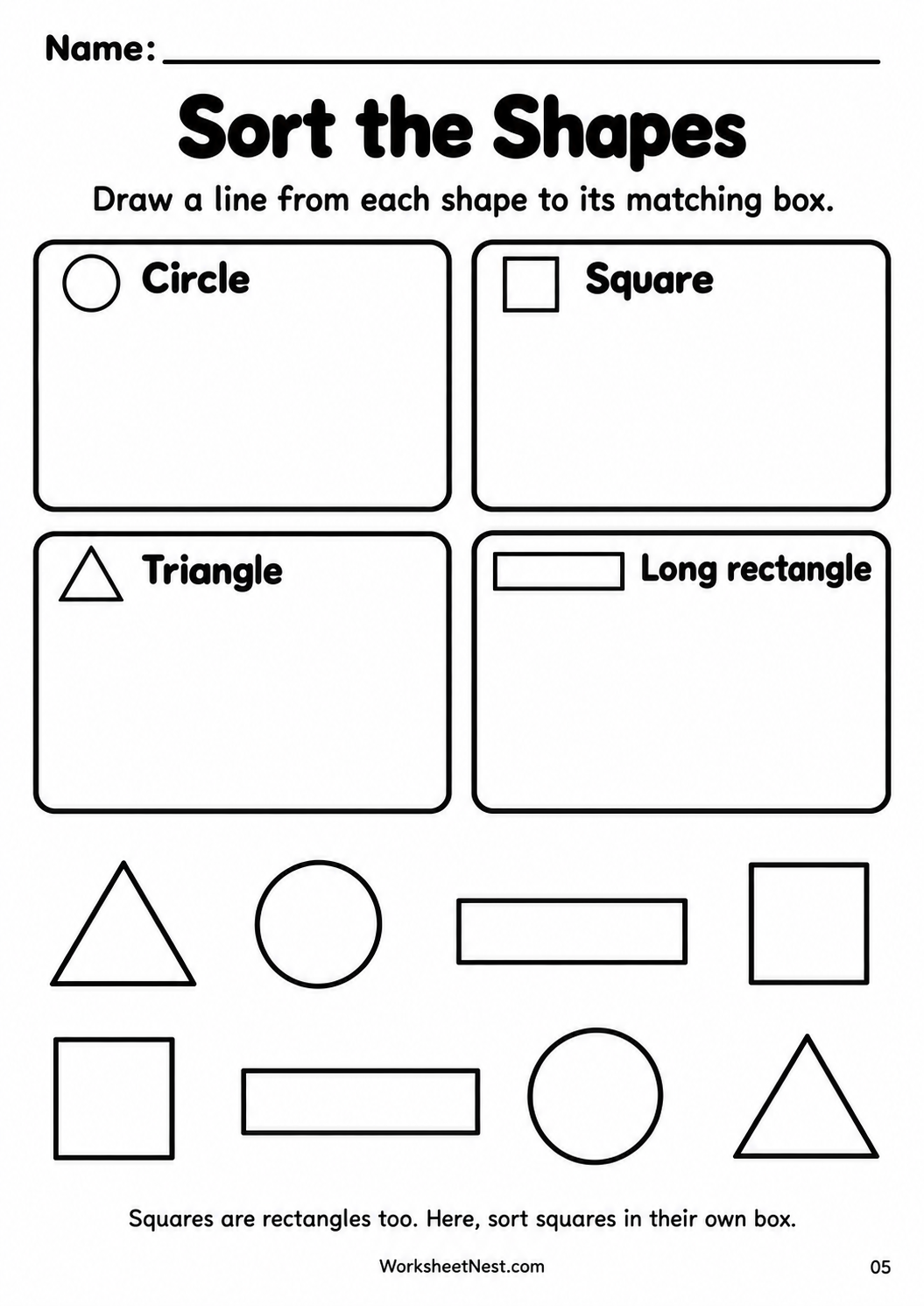
Eight shapes are connected to four labeled boxes: circle, square, triangle, and long rectangle. Each box has a small example to support the written label. The page explains that squares are rectangles too and asks children to put squares in their own box for this activity. Use that instruction to discuss grouping without teaching that squares cannot be rectangles.
06. Sides and Corners
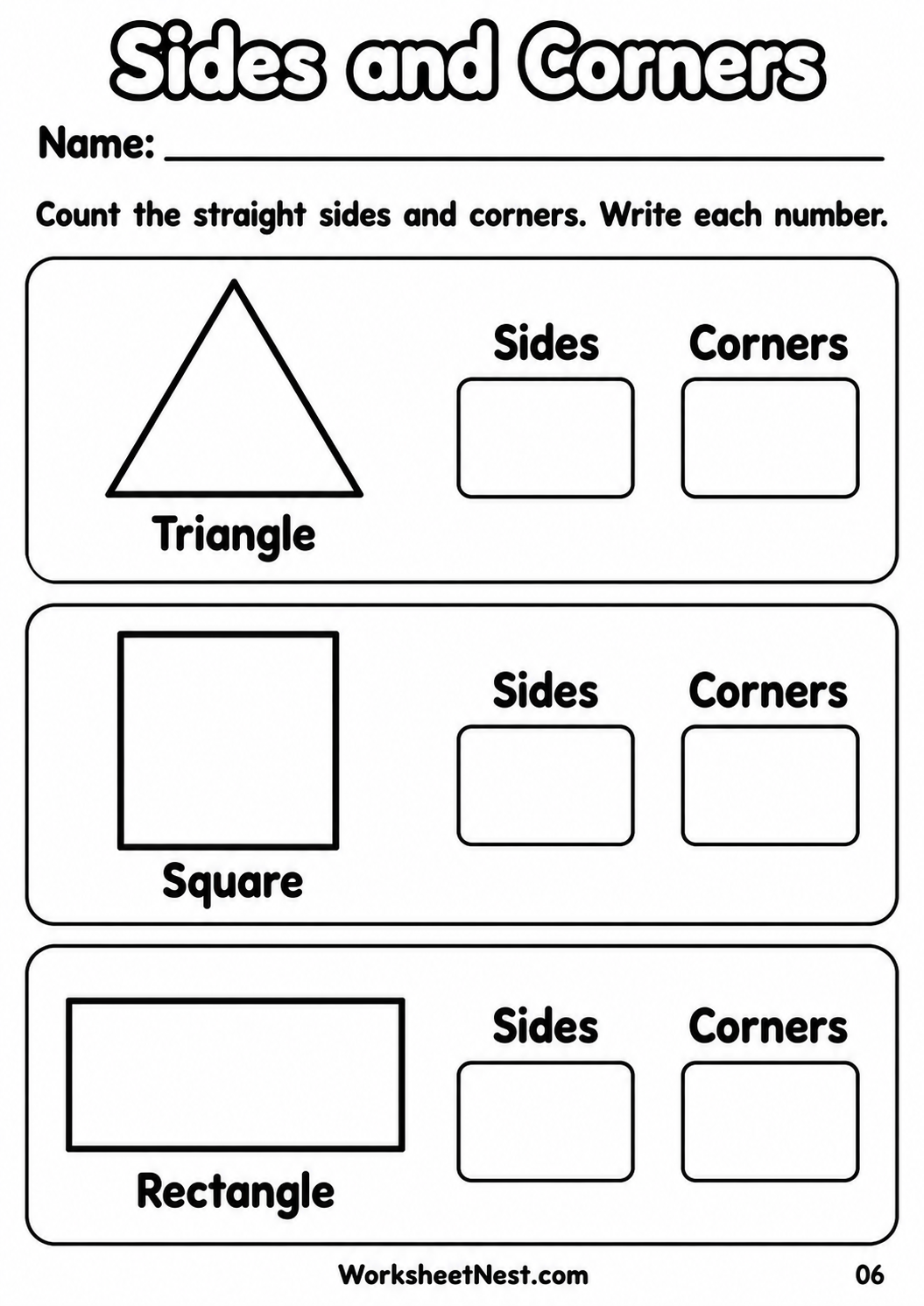
Children count straight sides and corners on a triangle, square, and rectangle, then write the totals in separate boxes. Ask the learner to point to one side at a time, returning to the start without counting it twice. Repeat for the corners. Comparing the square and rectangle provides an opportunity to notice their shared features.
07. Trace and Draw Shapes
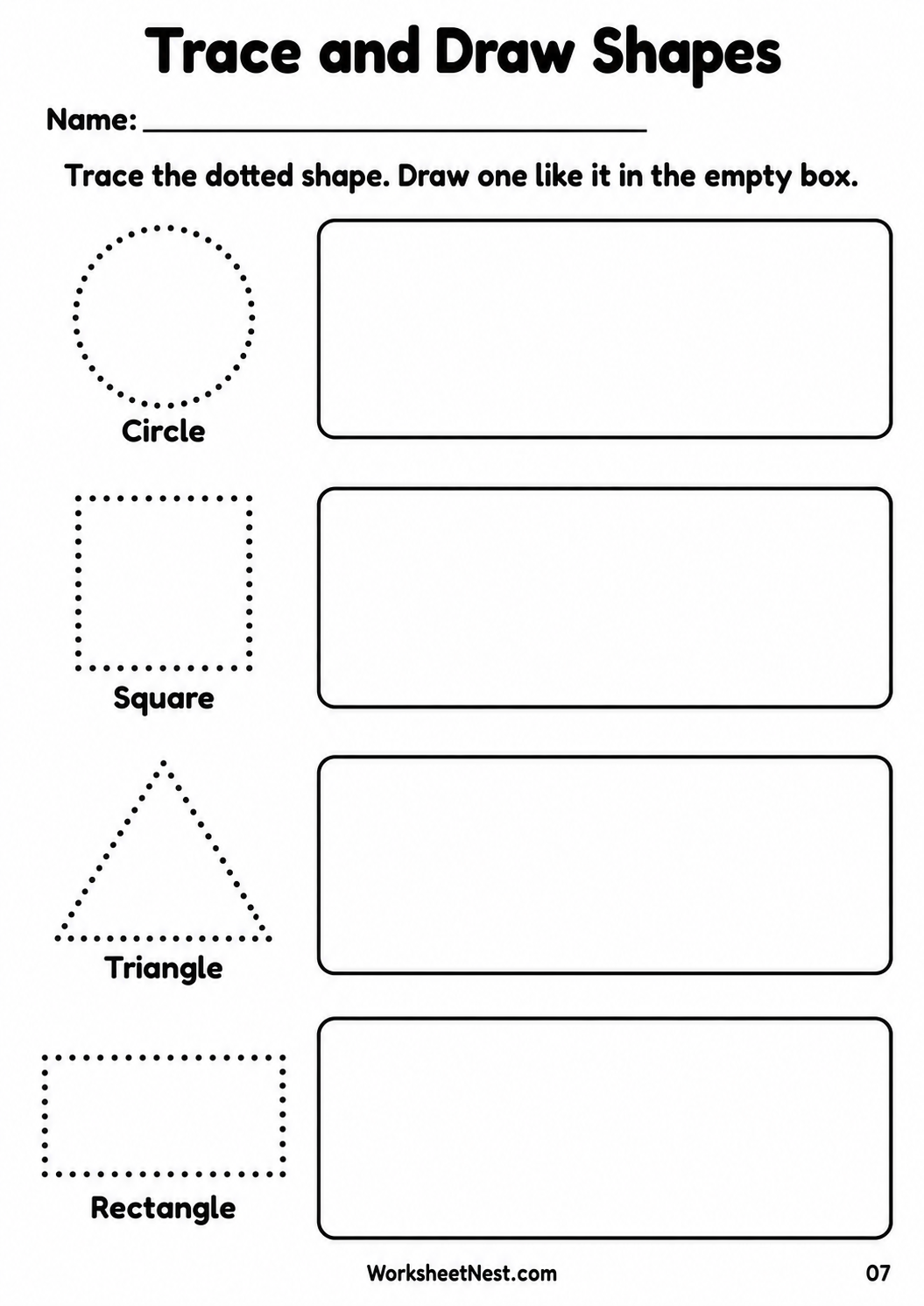
Each of four rows pairs a dotted shape with an empty drawing box. Children trace a circle, square, triangle, or rectangle and then draw a similar shape independently. The blank boxes allow space for a personal attempt. Focus feedback on the defining features of the shape instead of expecting the child’s drawing to match the model perfectly.
08. Count the Shapes
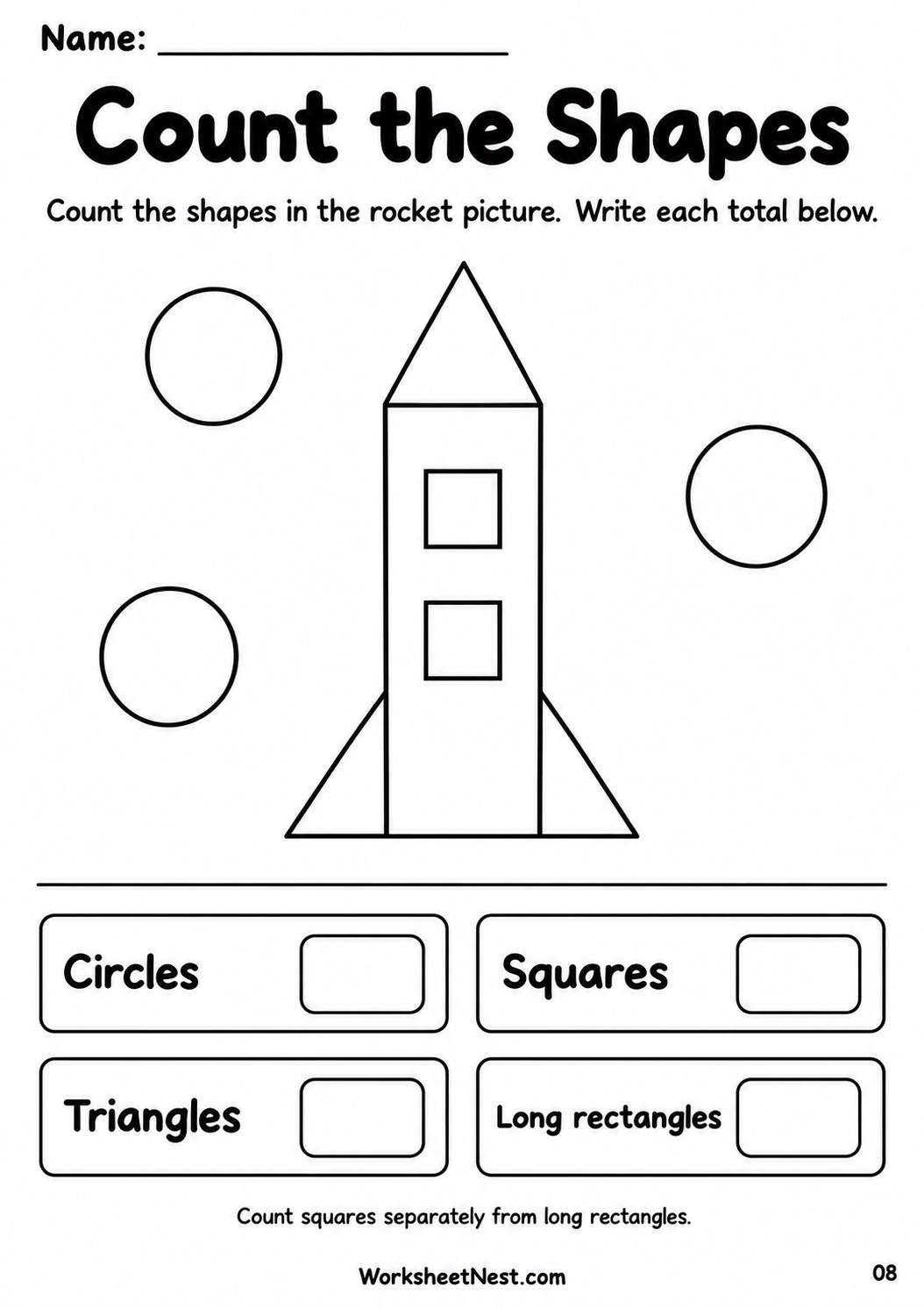
A simple rocket picture is built from separate circles, squares, triangles, and a long rectangle. Learners count each category and write a total below. The printed instruction asks them to count squares separately from long rectangles. Encourage a systematic search through the picture and a check of one category before recording its number.
09. Follow the Circle Path
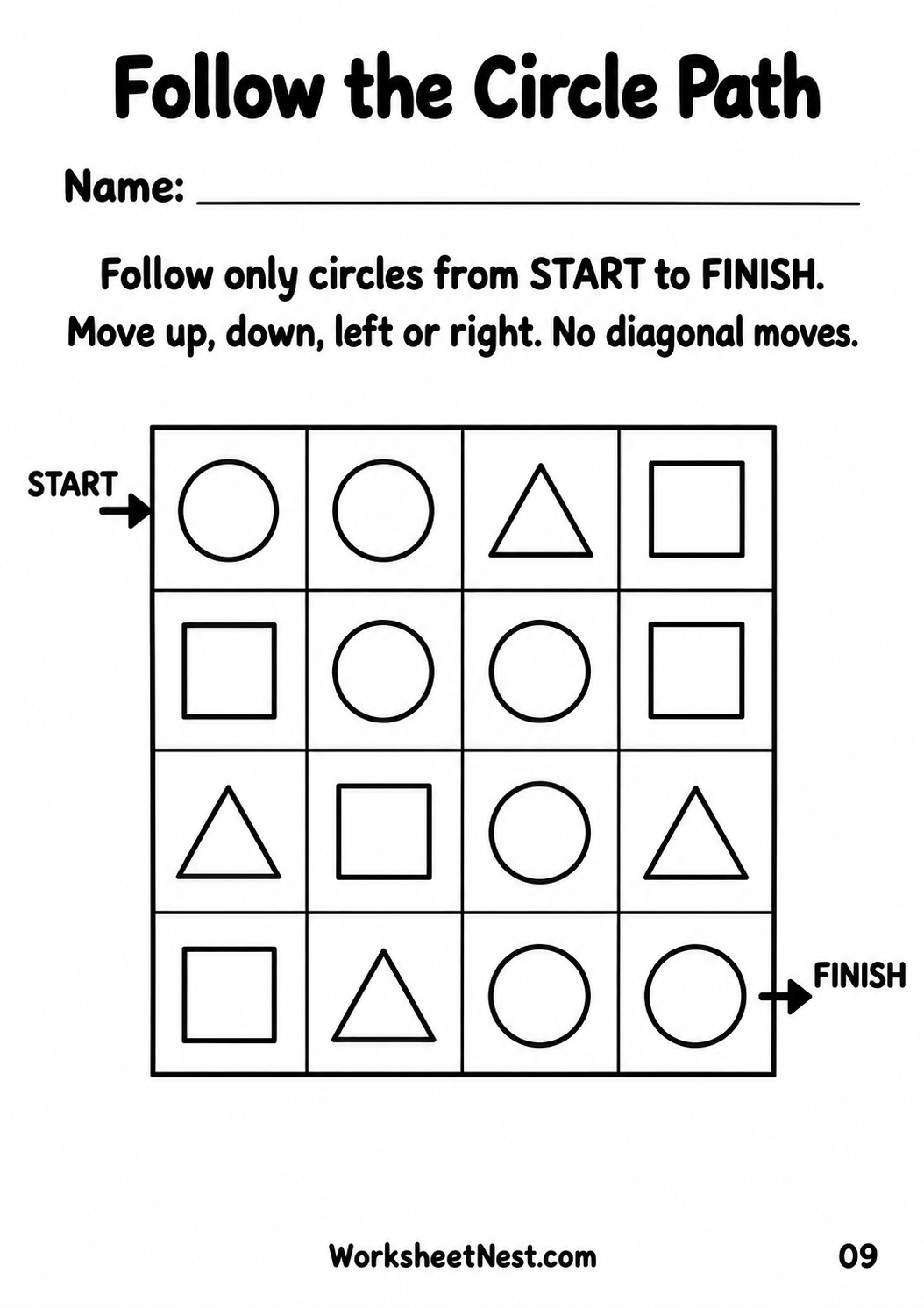
Children follow connected circle cells from START to FINISH in a mixed-shape grid. The page allows movement up, down, left, or right, with no diagonal moves. This adds a simple route-following task to shape recognition. Let the learner plan the route with a finger before drawing, checking that every visited cell contains a circle.
10. I Know My Shapes
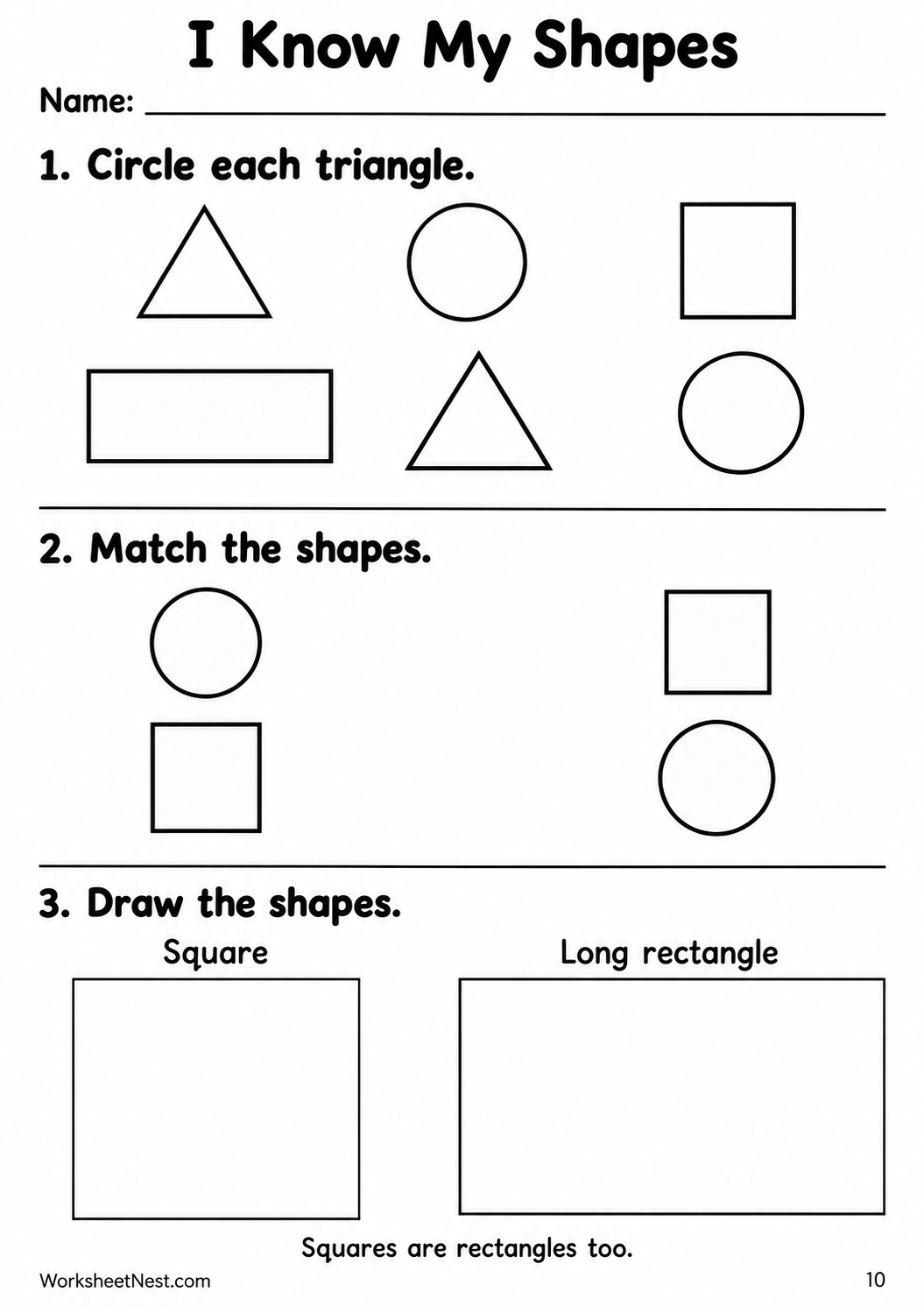
The review combines three responses: circle the triangles, match circles and squares, and draw a square and a long rectangle. A reminder states that squares are rectangles too. Use the page to notice which tasks children can explain confidently and which would benefit from another supported attempt, rather than judging their knowledge only by the neatness of their drawing.
Download 2D Shapes Worksheets and Teaching Guidance
Download the Complete Shapes Workbook
The actual source workbook contains eleven A4 pages: one colorful cover followed by the ten worksheets shown above. Use the whole sequence for varied practice, or choose an individual page for a short activity focused on tracing, identification, properties, or drawing.
Teaching Ideas
Start with a few visible outlines before introducing a whole page. Name each shape, trace its boundary with a finger, and talk about what makes it recognizable. For straight-sided shapes, count the sides and corners in a consistent direction. A triangle remains a triangle when it is smaller or turned; invite children to compare features rather than use size alone. For background on how young children learn to identify and compare shapes in different sizes and orientations, see this NAEYC article on discovering shapes and space in preschool.
Treat drawing as an opportunity to explain. A child may understand that a triangle needs three connected straight sides while still finding it difficult to control a pencil. Ask what the child intended to draw and offer another attempt. For the everyday-object page, look only at the outer edge named in the direction, keeping inner decoration separate from the matching task.
Keep the relationship between squares and rectangles accurate. Squares belong to the rectangle family. Some pages put squares and long rectangles in separate groups for a particular activity; follow those printed directions without saying that a square is never a rectangle. On the counting page, use the named categories as directed. On the path page, read the movement rule before beginning.
Learning Skills
This set provides practice recognizing four basic 2D shapes, matching outlines across sizes, connecting object outlines to shapes, identifying straight sides and corners, and drawing examples. The activities give several ways to respond, including circling, line matching, numeral writing, and drawing.
Printing and Preparation
The verified source PDF uses A4 portrait pages, approximately 210 × 297 mm. Choose A4 in the printer settings and inspect the preview. If printing on US Letter, use a suitable fit option and check the borders and footer; the printed scale will change. Print the cover in color if desired and the practice pages in black and white. A pencil is sufficient for the worksheet tasks.
License and Terms of Use Free for personal, homeschool, and classroom use. Printing and link-sharing are allowed. Selling, re-uploading, or redistributing these worksheets is not permitted.
Explore More Learning Activities
Shapes WorksheetsMath Worksheets