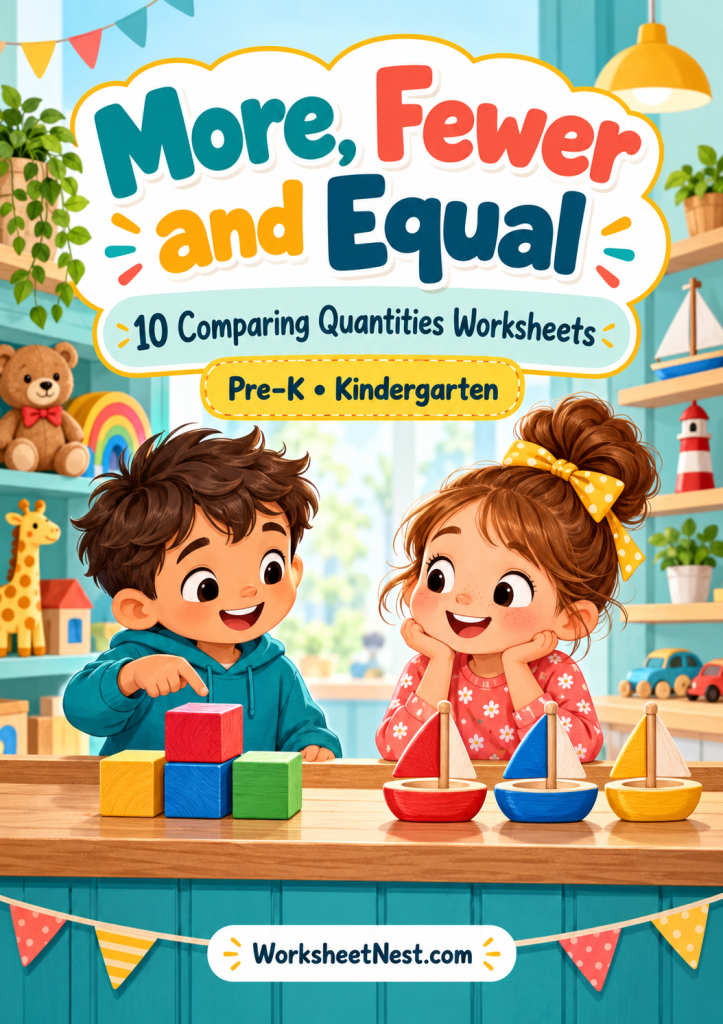
Give children a clear way to compare how many objects are in two groups with these more fewer and equal worksheets. Ten black-and-white activities introduce matching, counting, choosing a larger or smaller group, recognizing equal quantities, and adding drawings to make groups match. A separate colorful cover introduces the collection.
The pages suit preschool and kindergarten learners who are beginning to count small groups, with an adult available to read directions. Early tasks use quantities within five; later comparisons include groups up to ten. Children respond by connecting, circling, or drawing. The focus is the number of objects, so learners need to look beyond the size of a picture or the space a group fills.
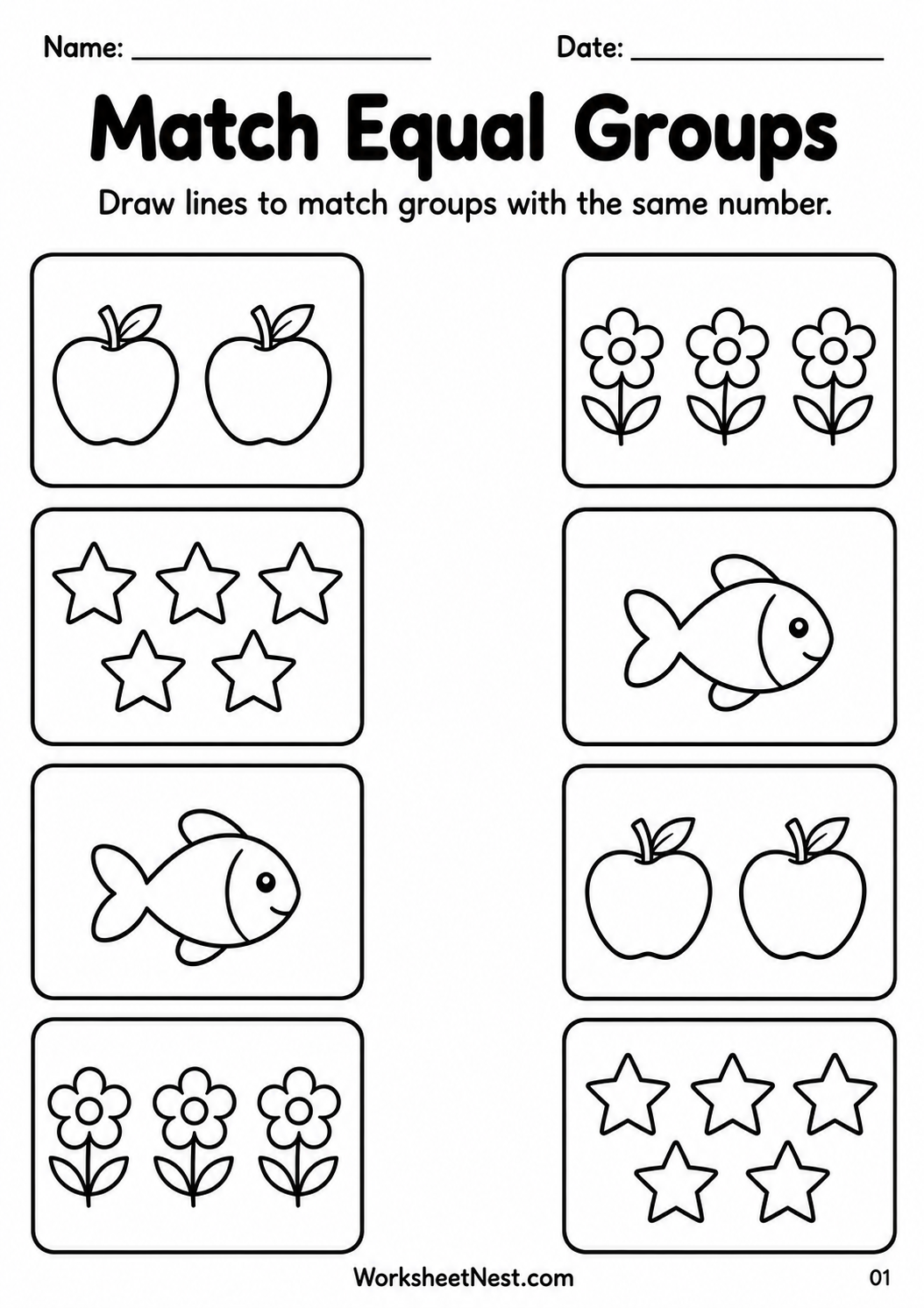
01. Match Equal Groups
Children connect groups that contain the same number of objects. The two columns show apples, stars, a fish, and flowers in a different order. Counting each box helps learners find its partner even when the pictures are different. Encourage the child to explain that equal means the same quantity, rather than simply finding two boxes with the same kind of picture.
Download Worksheet 01 PDF
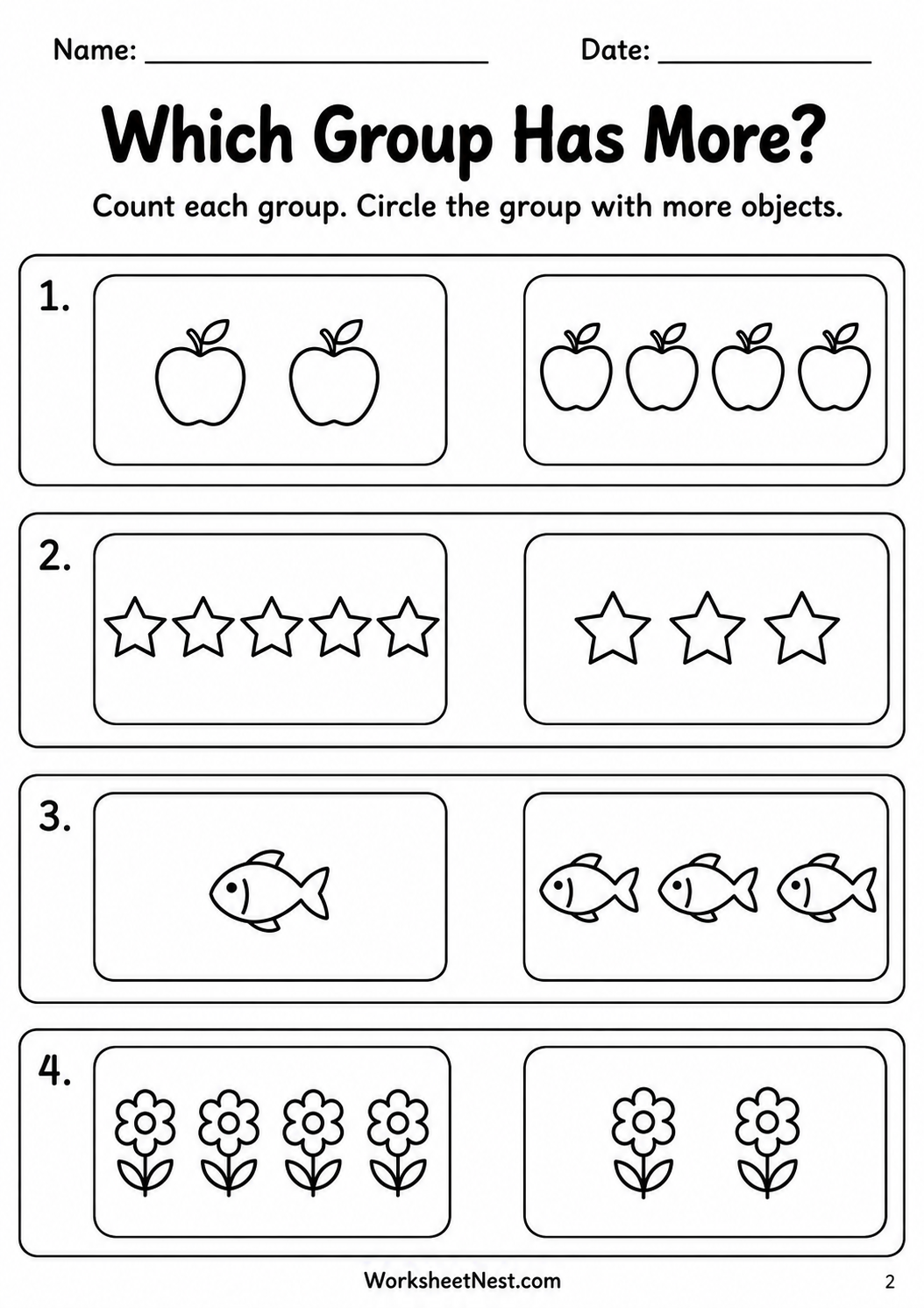
02. Which Group Has More?
Four rows compare groups of apples, stars, fish, and flowers. Children count both boxes and circle the group with more objects. The larger group appears on different sides, so learners need to examine each row. Ask for a complete explanation such as, “This group has more because it has four and the other has two.”
Download Worksheet 02 PDF
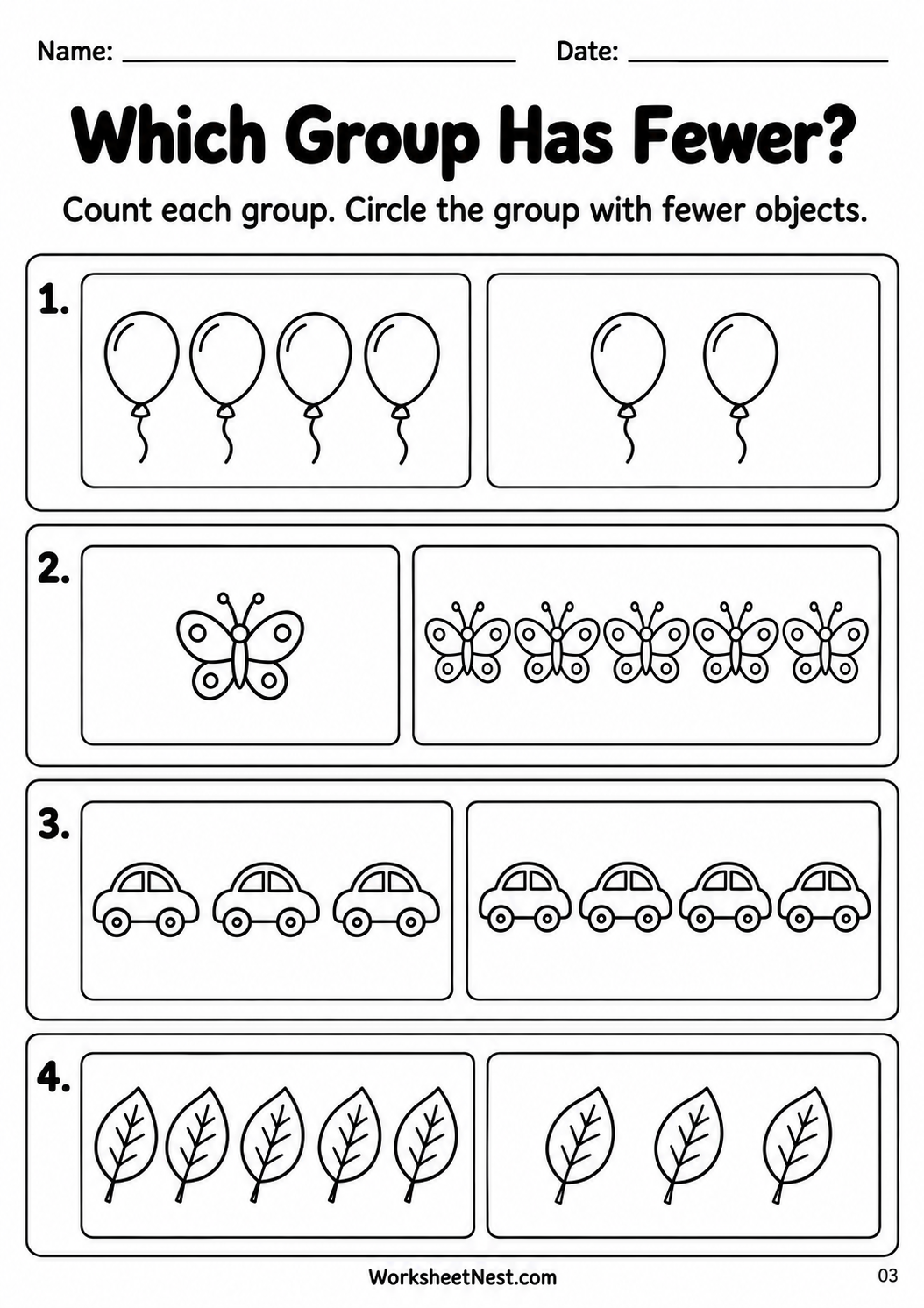
03. Which Group Has Fewer?
This page changes the question to finding the smaller quantity. Balloons, butterflies, cars, and leaves give children four comparisons to count and circle. Read the word fewer before starting so that a familiar circling routine does not lead to choosing more automatically. After a choice, ask the learner to point to the group with more as a quick check.
Download Worksheet 03 PDF
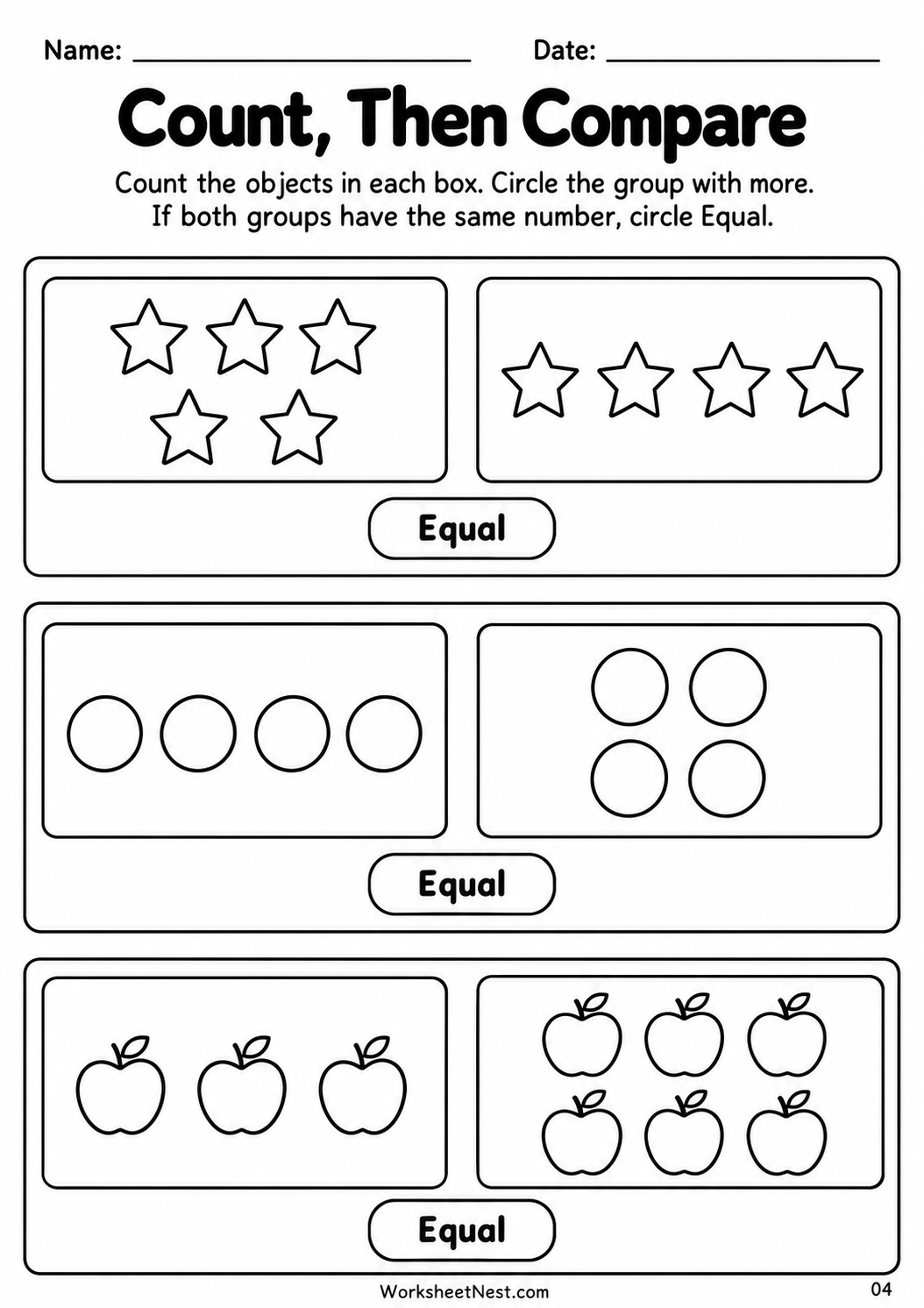
04. Count, Then Compare
The objects appear in different arrangements, including a row of four circles beside four circles arranged in two rows. Children count both groups and circle the group with more, or the Equal option when the quantities match. The page helps show that spreading objects out or arranging them differently does not by itself change how many there are.
Download Worksheet 04 PDF
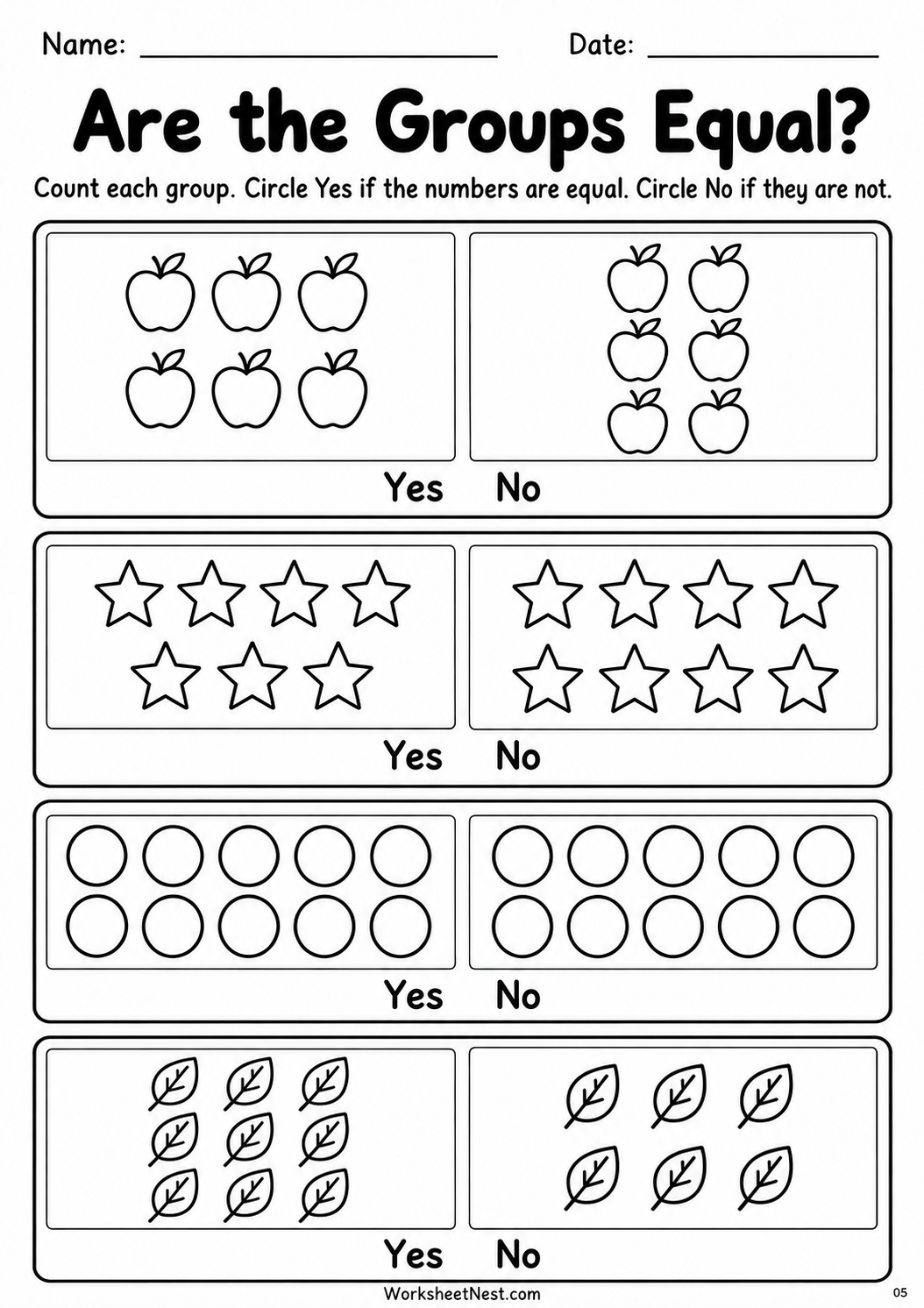
05. Are the Groups Equal?
Children decide whether the two groups in each row contain the same number and circle Yes or No. Apples, stars, circles, and leaves provide comparisons within ten, including both matching and different totals. Count each side carefully before deciding. Equal groups can have different arrangements, and a nearly matching pair still needs to be checked one object at a time.
Download Worksheet 05 PDF
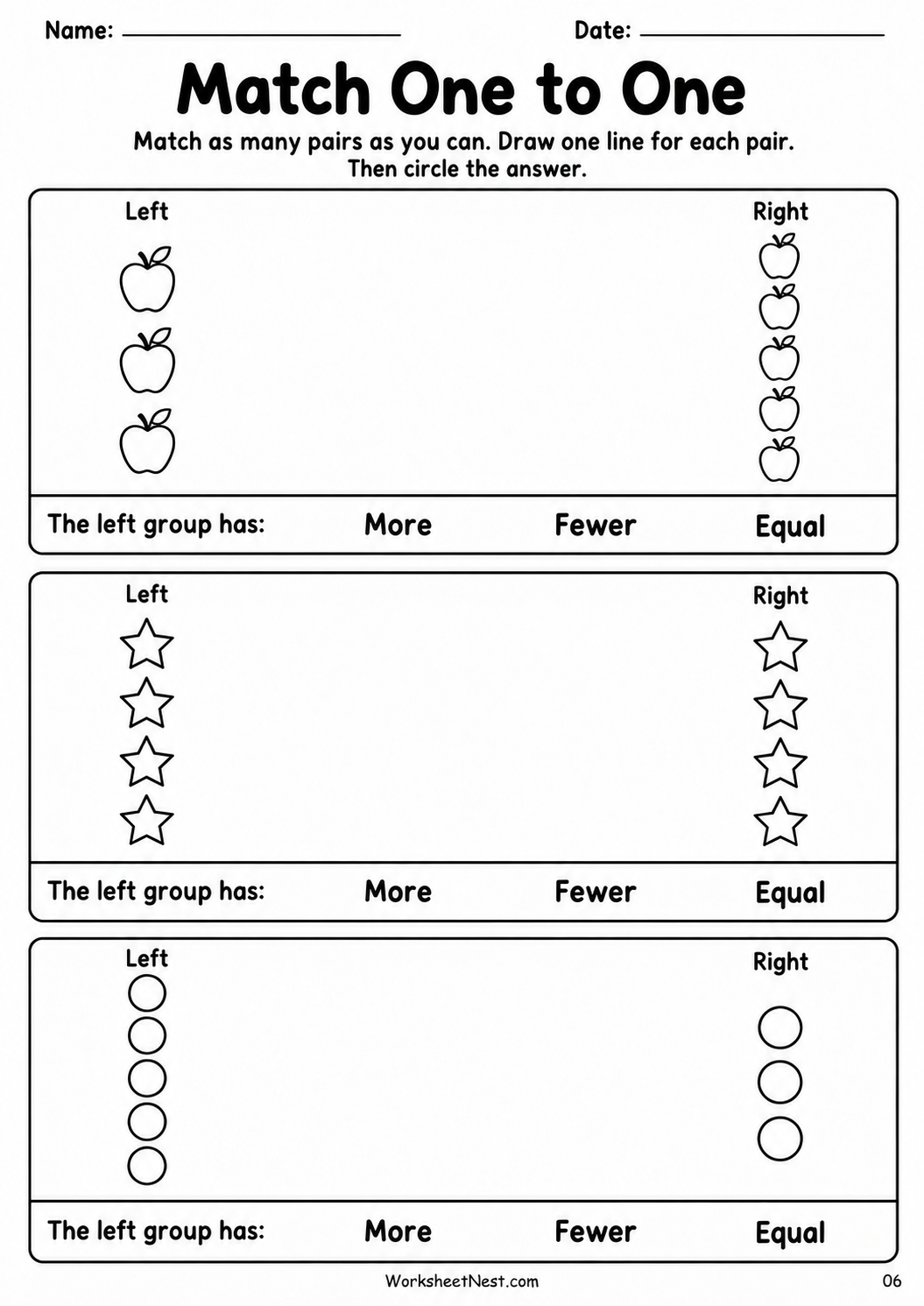
06. Match One to One
Learners draw one line for each pair they can make across the two groups. Some objects can remain unmatched. They then describe the left group by circling More, Fewer, or Equal. This makes pairing a useful comparison strategy alongside counting. Keep attention on the left group when reading the answer choices, since changing the reference group changes the statement.
Download Worksheet 06 PDF
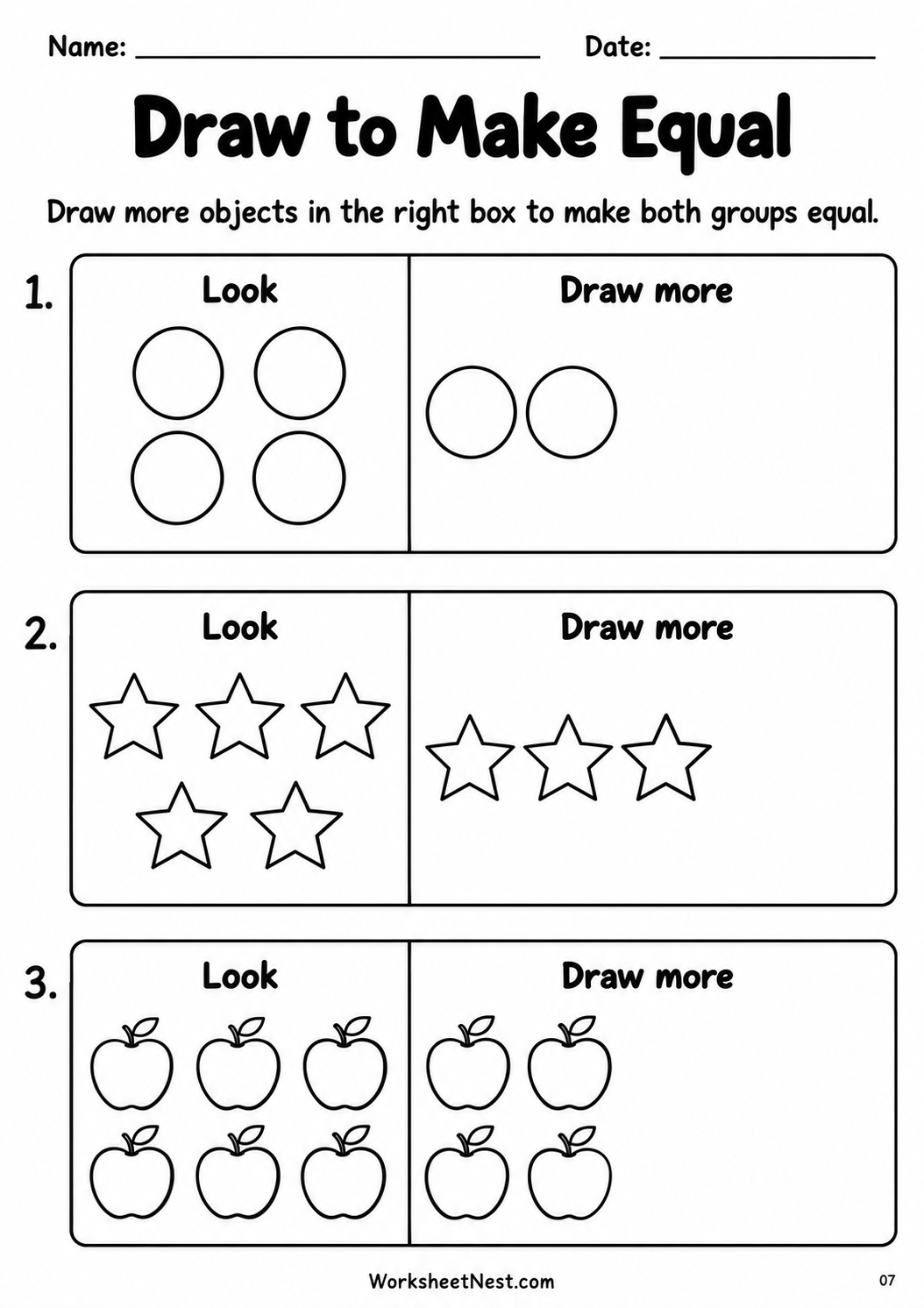
07. Draw to Make Equal
Each row has a model group on the left and a smaller group on the right. Children add drawings in the right box until both groups contain the same number. The pictures include circles, stars, and apples. Count the existing right-side objects before adding any more, then recount the completed group to check that it matches the model.
Download Worksheet 07 PDF
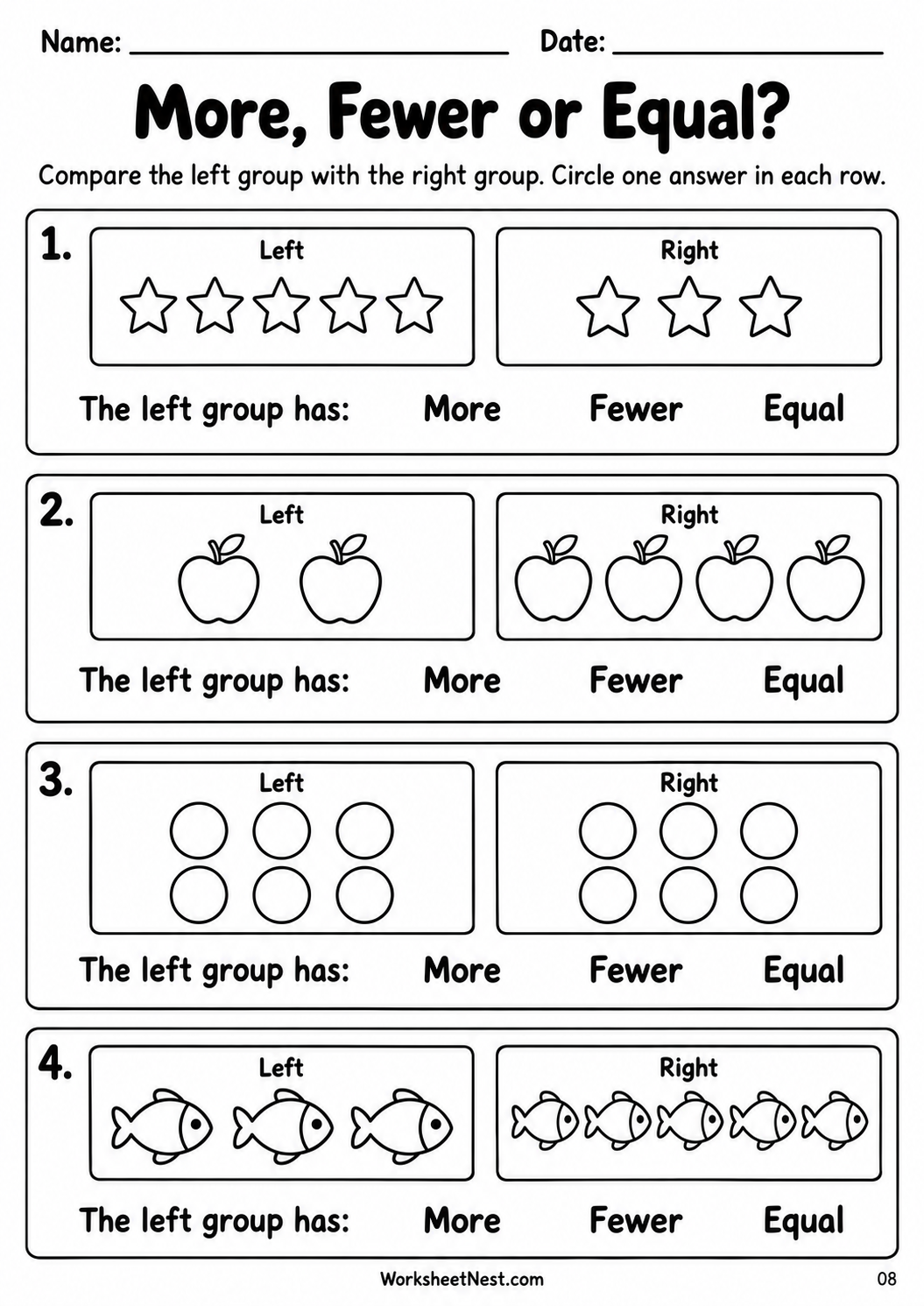
08. More, Fewer or Equal?
Four rows ask learners to compare the left group with the right group and circle the word that describes the left. Stars, apples, circles, and fish include all three relationships. Read the reference-group instruction aloud before each response. The fish also provide a useful reminder to count the pictures rather than judge their quantity from individual picture size.
Download Worksheet 08 PDF
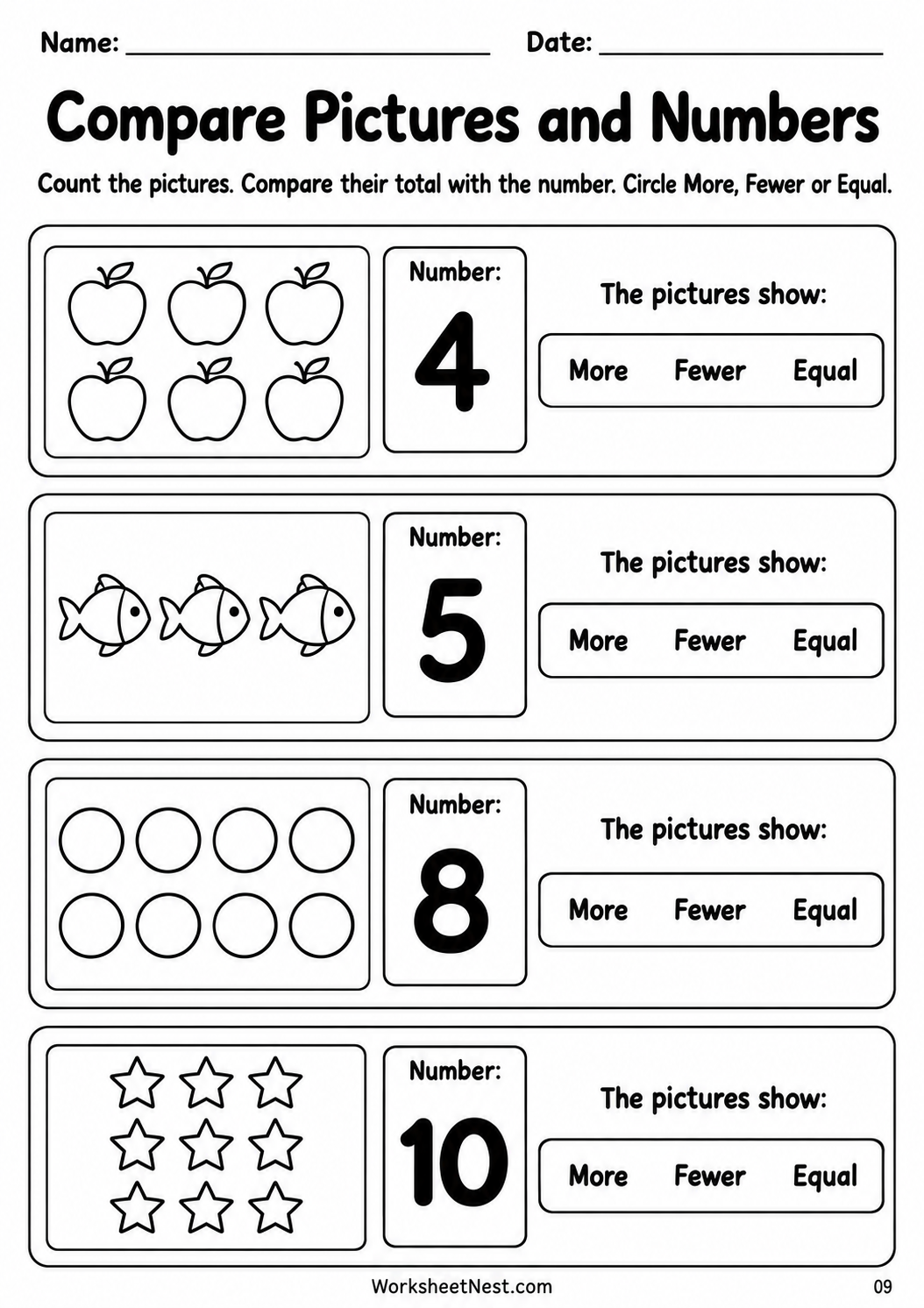
09. Compare Pictures and Numbers
Each pictured group appears beside a written numeral. Children count the pictures, compare that total with the numeral, and circle More, Fewer, or Equal. This connects a visible quantity with a number representation instead of comparing two picture groups. An adult can name an unfamiliar numeral so the learner can still explain the comparison without getting stuck on reading it.
Download Worksheet 09 PDF
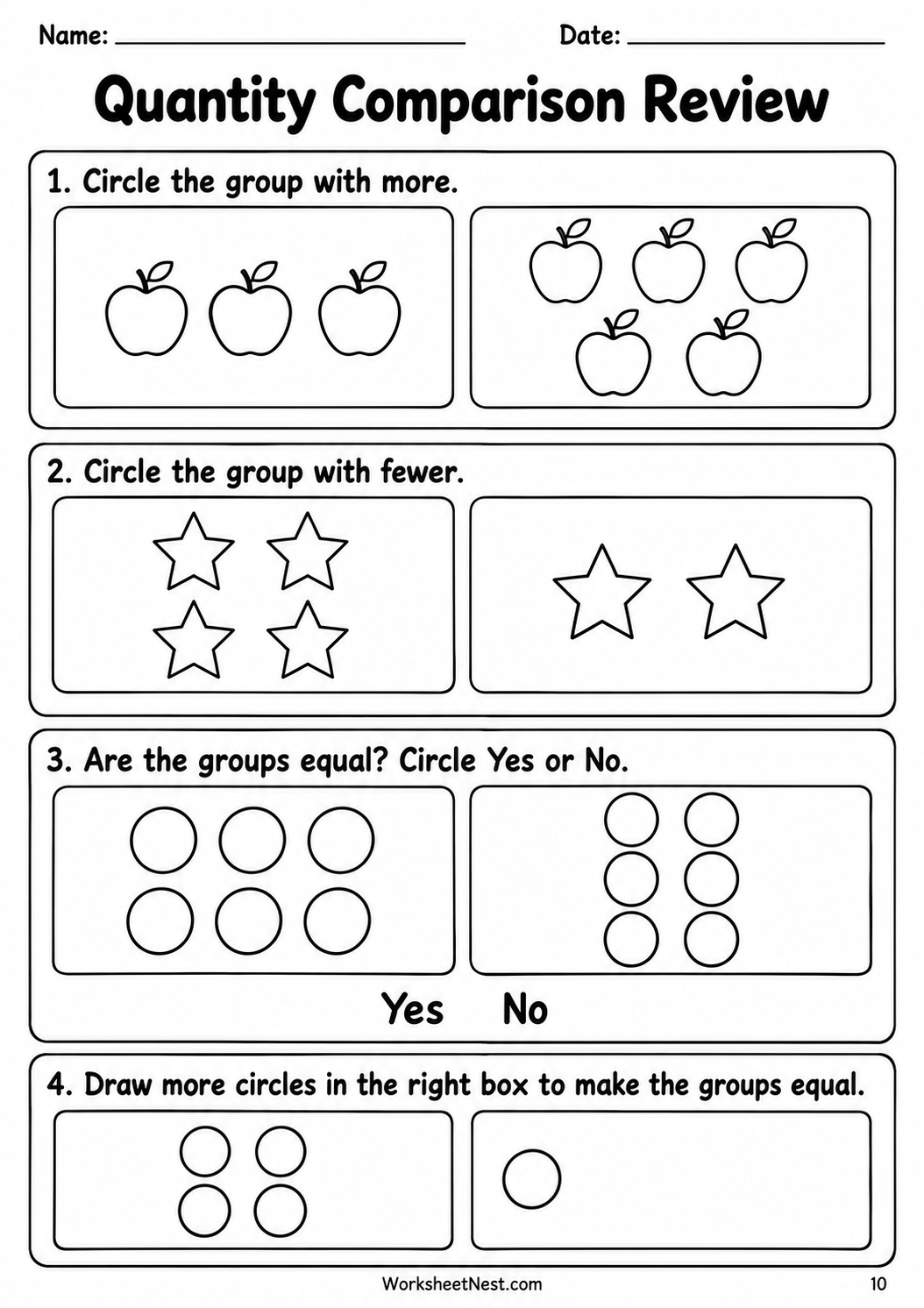
10. Quantity Comparison Review
The final worksheet combines four response types: circle the group with more, circle the group with fewer, decide whether two groups are equal, and draw more circles in the right box to make the groups match. Read each direction separately. The changing instructions make this a useful review of both quantity comparison and understanding what each task asks.
Download Worksheet 10 PDF
Download the Complete Worksheet Bundle
Get all ten comparison activities together with the colorful cover in one eleven-page PDF. Use the pages in order for a broad introduction, or choose an activity that matches the comparison your child is practising.
Download the Complete More, Fewer and Equal PDF Bundle
Teaching and Learning Guidance
Begin with two small collections of familiar objects, such as blocks. Touch each object once as you count, then say how many are in each group. Move to a worksheet when the learner can connect the counted total with the group. One page or a few rows can provide enough practice for a short session.
Use Matching and Counting
Place objects in pairs to demonstrate one-to-one matching. If every object has a partner and none remain, the groups are equal. If one side has objects left over, that side has more. Connect this hands-on routine to page 06, where the drawn lines represent pairs. Do not require every object to have a partner when the quantities differ.
Keep the Comparison Clear
Use fewer for a smaller number of countable objects and explain equal as the same number. Ask which group the sentence describes before choosing an answer. Pages 06 and 08 refer to the left group; page 09 compares the pictured total with a numeral. Naming the reference group helps avoid a correct count followed by a reversed comparison.
Check Quantity, Not Appearance
Rearrange a small group without adding or removing anything and count it again. Invite the child to notice that the quantity stays the same. On the drawing pages, focus on how many new objects are needed rather than neatness. Accept recognizable marks and ask the learner to recount both completed groups. Return to real objects if counting or drawing becomes frustrating.
Illinois Early Learning Project describes comparing two collections to see whether they are equal or which has more, using words such as more, fewer, and equal.
Using the Activity Pages
Have a pencil ready and read the selected instruction aloud. The activities use connecting lines, circled choices, and added drawings; there is no cutting or gluing task. Choose a simpler matching or more/fewer page before the mixed review when needed. Give learners time to explain their decisions rather than treating quick answers as the only sign of understanding.
Printing Your Worksheets
The PDF pages use A4 portrait paper. Choose A4 and check the print preview before printing. Start with one test page, using your printer’s fit-to-printable-area option if needed to keep the page edges visible. The activity pages can be printed in black and white; the cover is in color. Children can use a pencil for matching, circling and drawing, then explain how they compared each group.
Common Core Connections
These worksheets offer partial practice with the Common Core State Standards (Kindergarten) listed below. This is partial practice only, not full alignment with a standard.
K.CC.C.6 asks children to identify whether one group has more, fewer, or the same number of objects as another, using matching and counting. Worksheets 01, 02, 03, 04, 05, 06, 08, and 10 give partial practice with this skill. See the Common Core State Standards (Kindergarten) page for K.CC.C.6.
K.CC.B.4.a asks children to pair each object with one number name when counting. Worksheets 02, 03, 04, and 05 give partial practice with this skill, and their instructions say “Count each group” as the comparison step. See the Common Core State Standards (Kindergarten) page for K.CC.B.4.a.
Note: K.CC.C.7 is not claimed here. Worksheet 09 compares a counted group with a numeral, so the two-numeral comparison standard is not claimed.
License and Terms of Use Free for personal, homeschool, and classroom use. Printing and link-sharing are allowed. Selling, re-uploading, or redistributing these worksheets is not permitted.