Start with a page that shows objects already crossed out. Ask your child to point to each object that remains and count it once. Later pages ask children to make the changes themselves. An adult can read the directions and stories aloud while the child works with the pictures.
01 — How Many Are Left?
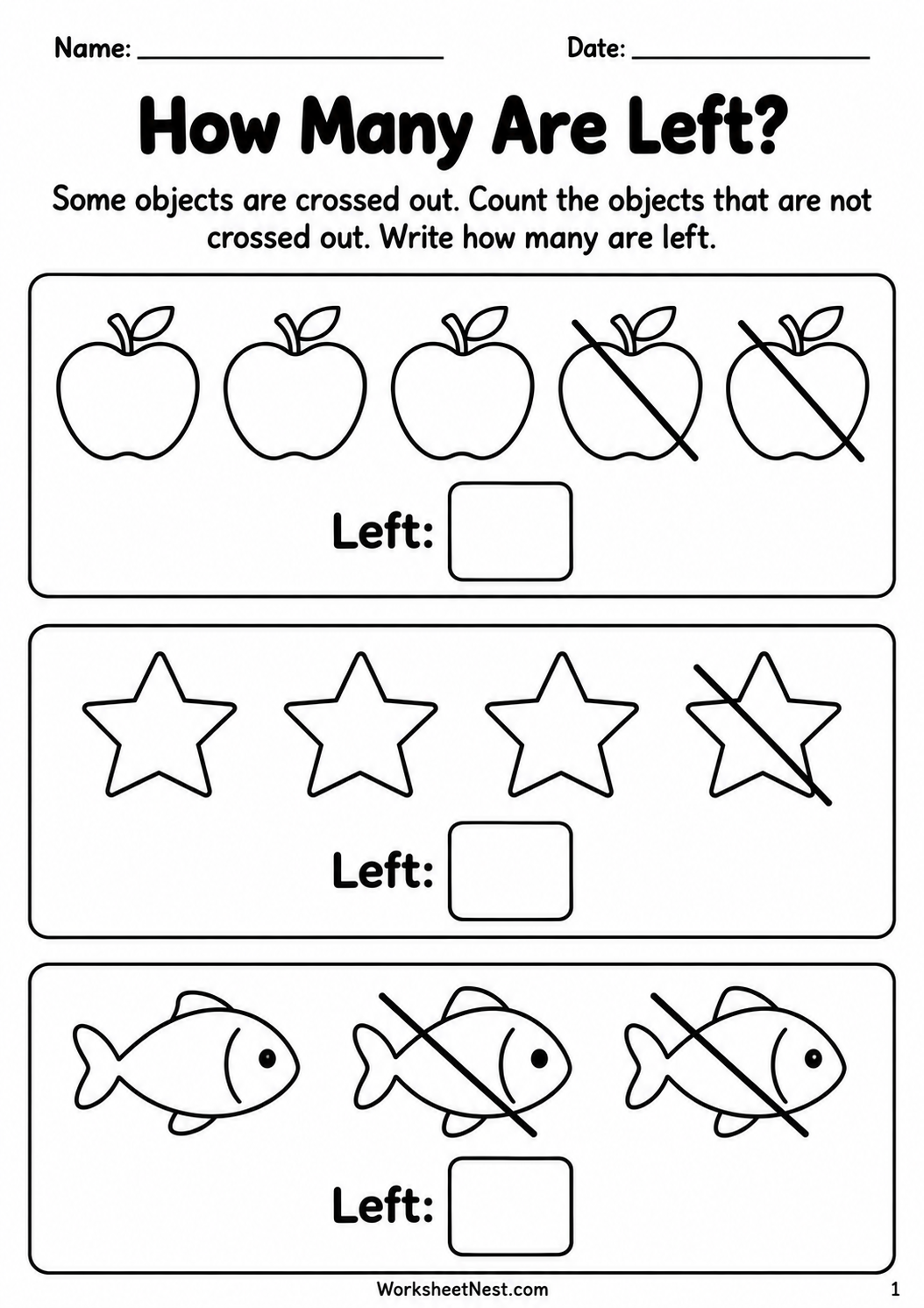
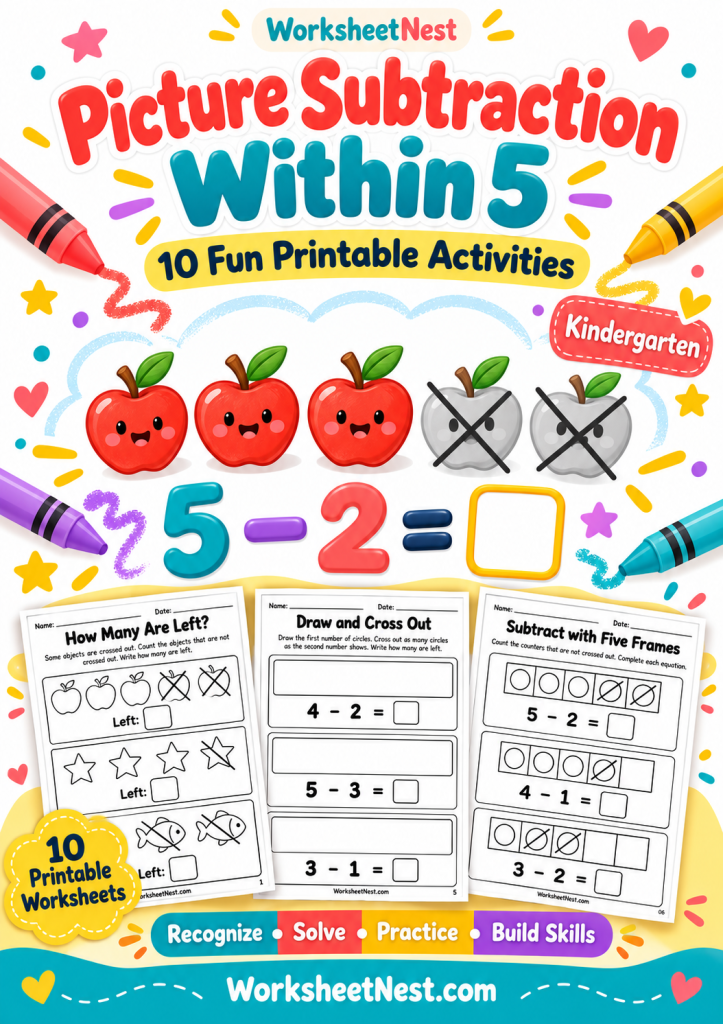
Some objects are already crossed out. Children count the apples, stars and fish that remain and write each total in the answer box. The three groups represent five take away two, four take away one and three take away two. Encourage learners to look carefully at the marks before counting; a crossed-out object is still visible but is no longer included in what is left.
02 — Cross Out and Count
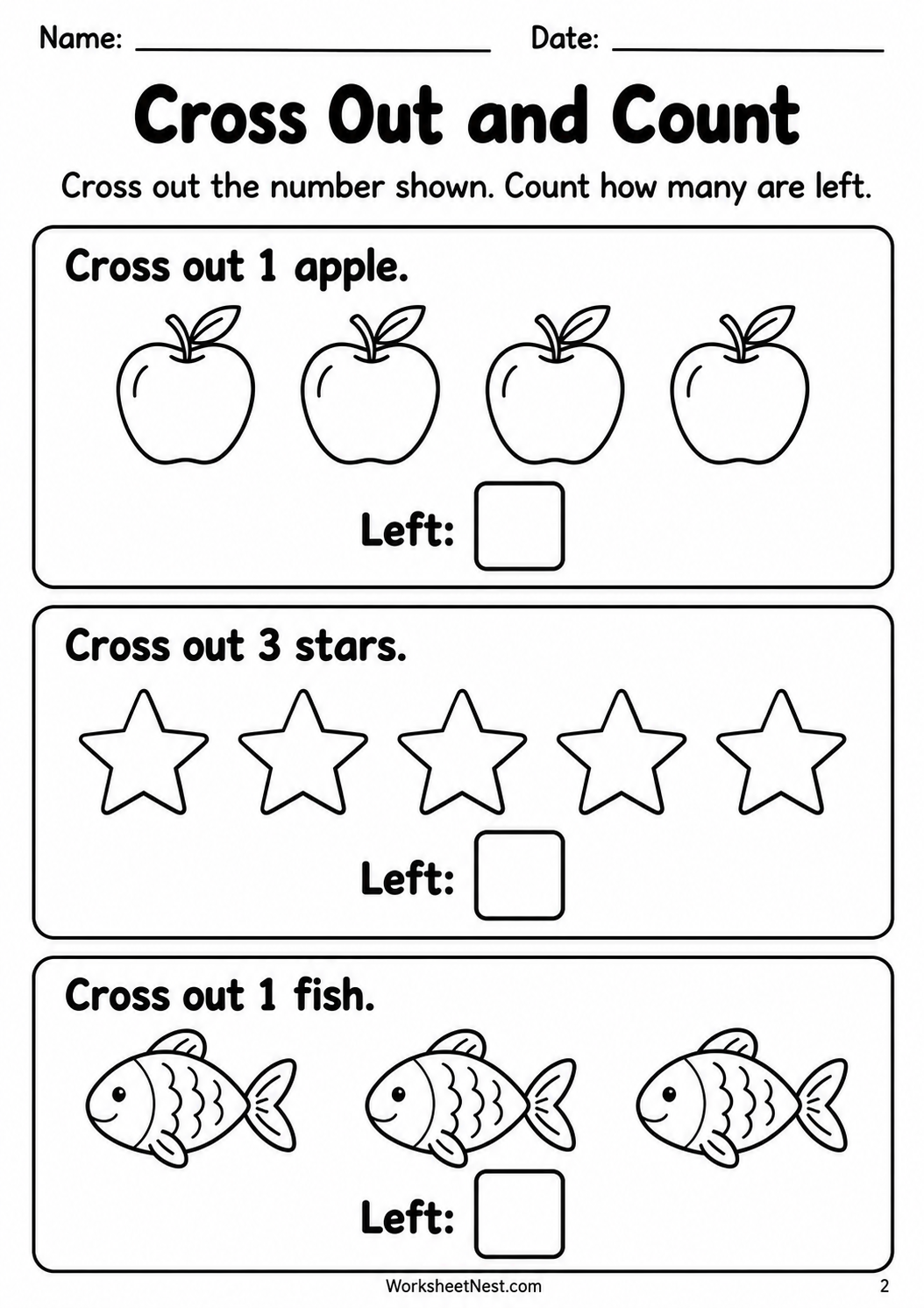
This time, the child makes the crossing-out marks. The page asks learners to cross out one apple from four, three stars from five and one fish from three. After each change, children count what remains and write the number. A simple diagonal line through each selected object keeps the original group visible and helps an adult see how the child represented the subtraction.
03 — Match What Is Left
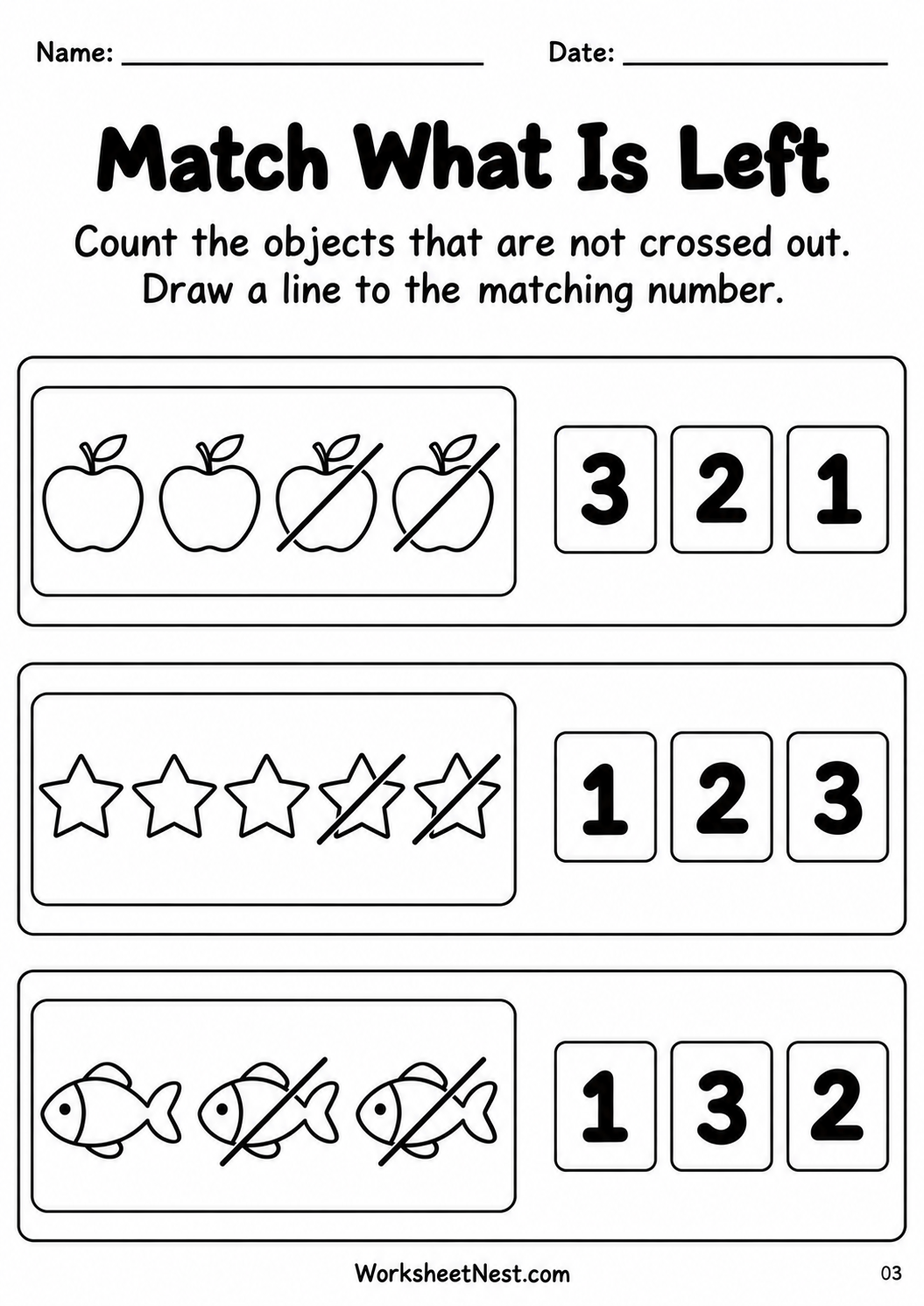
Children count the objects that are not crossed out, then draw a line to the matching numeral. Each row offers three number choices. Apples, stars and fish represent four take away two, five take away two and three take away two. This activity lets children show an answer by matching rather than writing a numeral, making it useful when number formation still takes extra effort.
04 — Complete the Subtraction
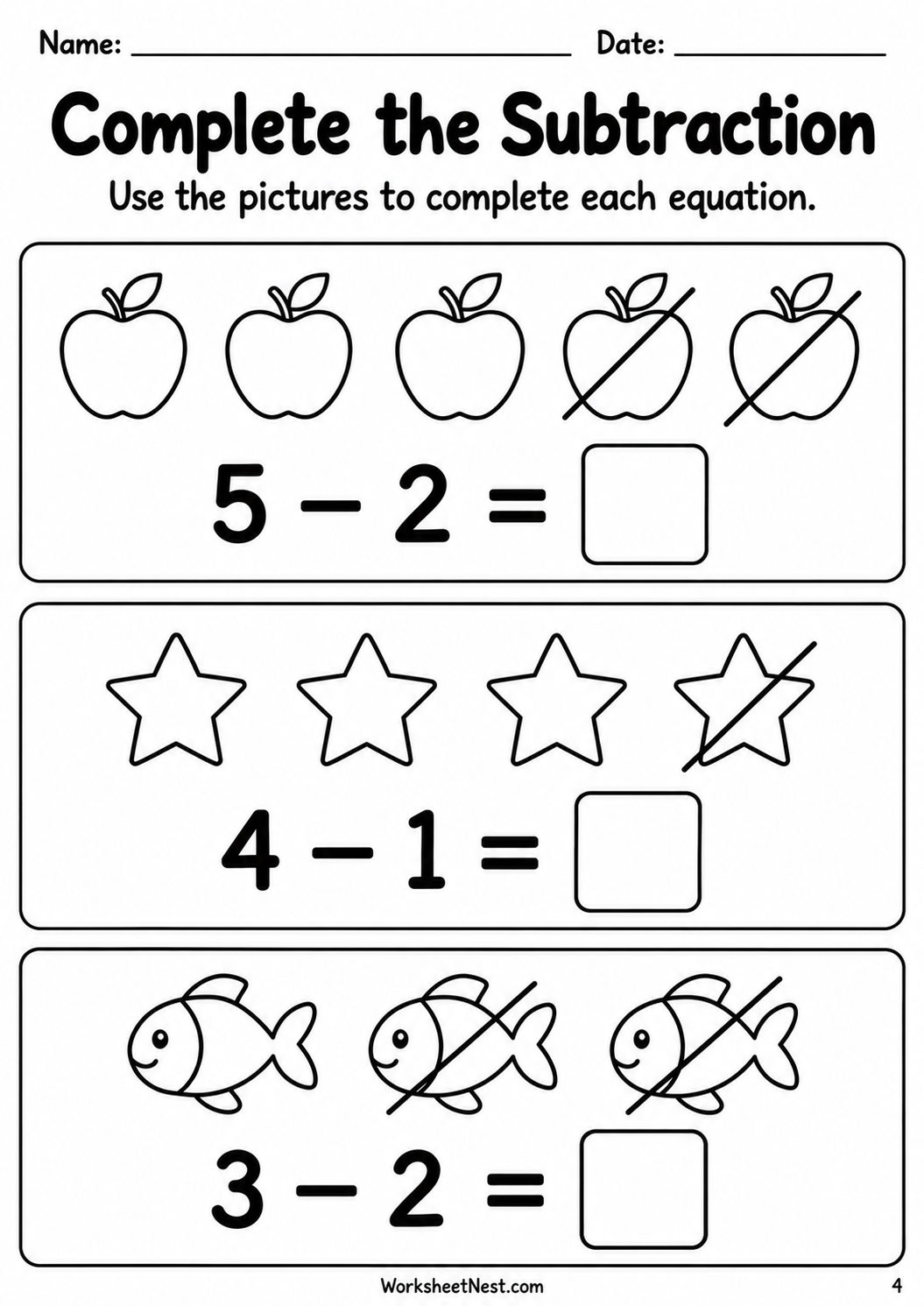
Pictures sit above incomplete subtraction equations. Children count the remaining apples, stars and fish, then fill in each result. The equations are 5 − 2, 4 − 1 and 3 − 2. Point to the first number, the subtraction sign and the second number while discussing the picture. This helps connect the written equation with the group and the objects taken away.
05 — Draw and Cross Out
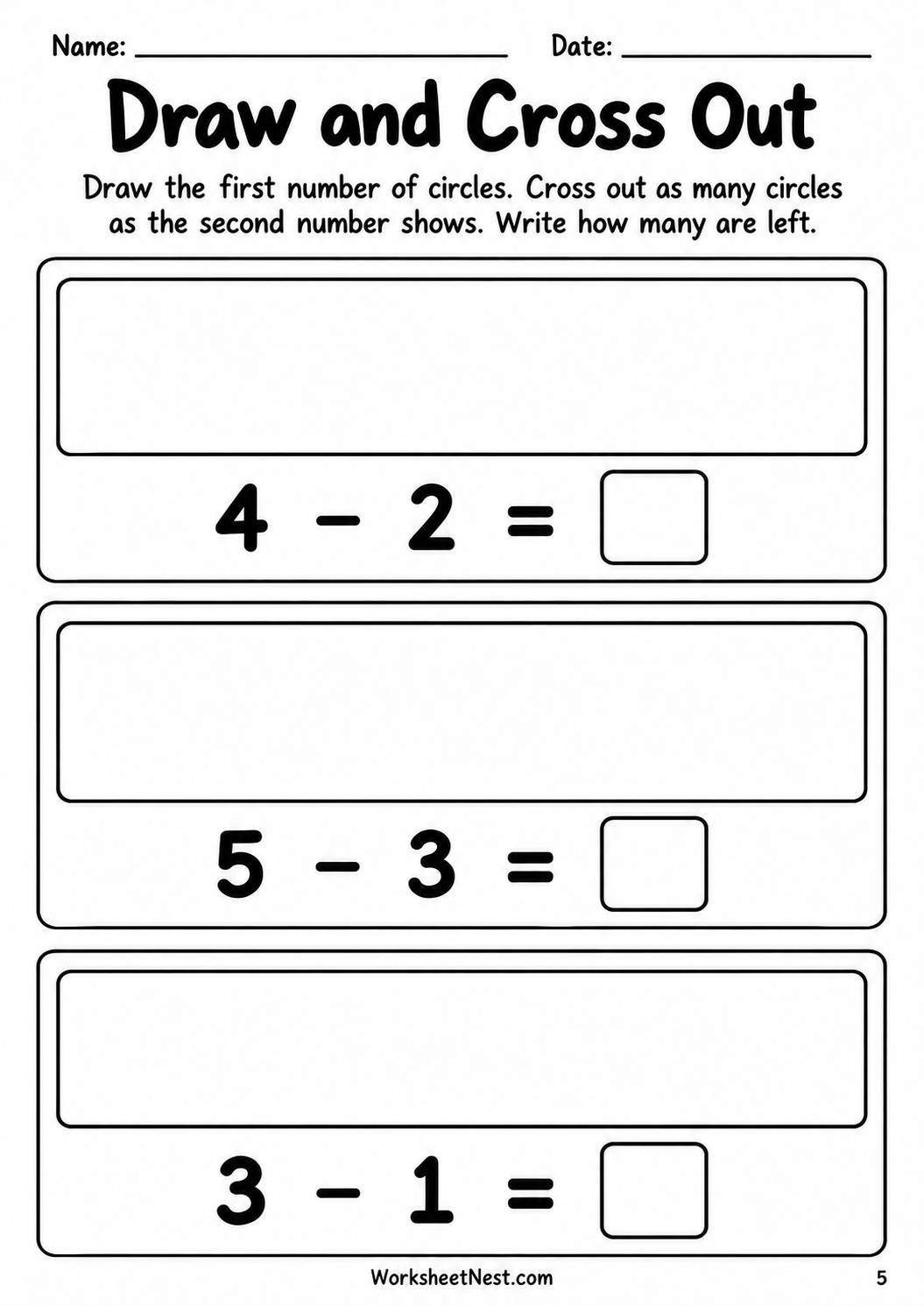
Three empty drawing boxes give children room to model subtraction themselves. For 4 − 2, 5 − 3 and 3 − 1, they draw the first number of circles, cross out the second number of circles and write how many remain. Keep the circles simple. The purpose is to represent quantities clearly, so children can spend their attention on counting and taking away.
06 — Subtract with Five Frames
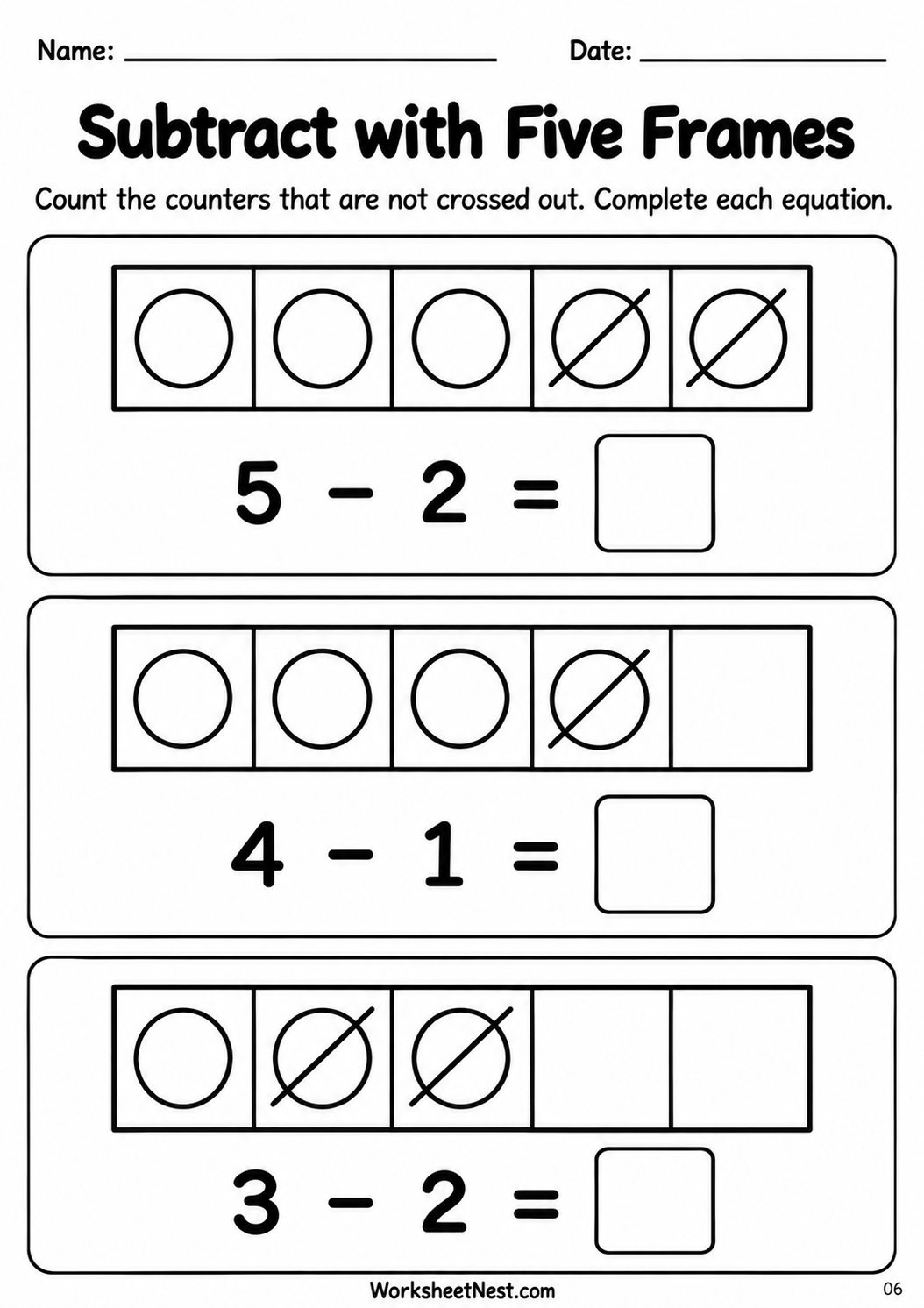
Five-cell frames organize the counters in a steady row. Learners count the counters that are not crossed out and complete 5 − 2, 4 − 1 and 3 − 2. Some cells are empty because a starting group may contain fewer than five counters. Remind children to count actual counters rather than every cell, and to leave the crossed-out counters out of the remaining total.
07 — Subtracting Zero
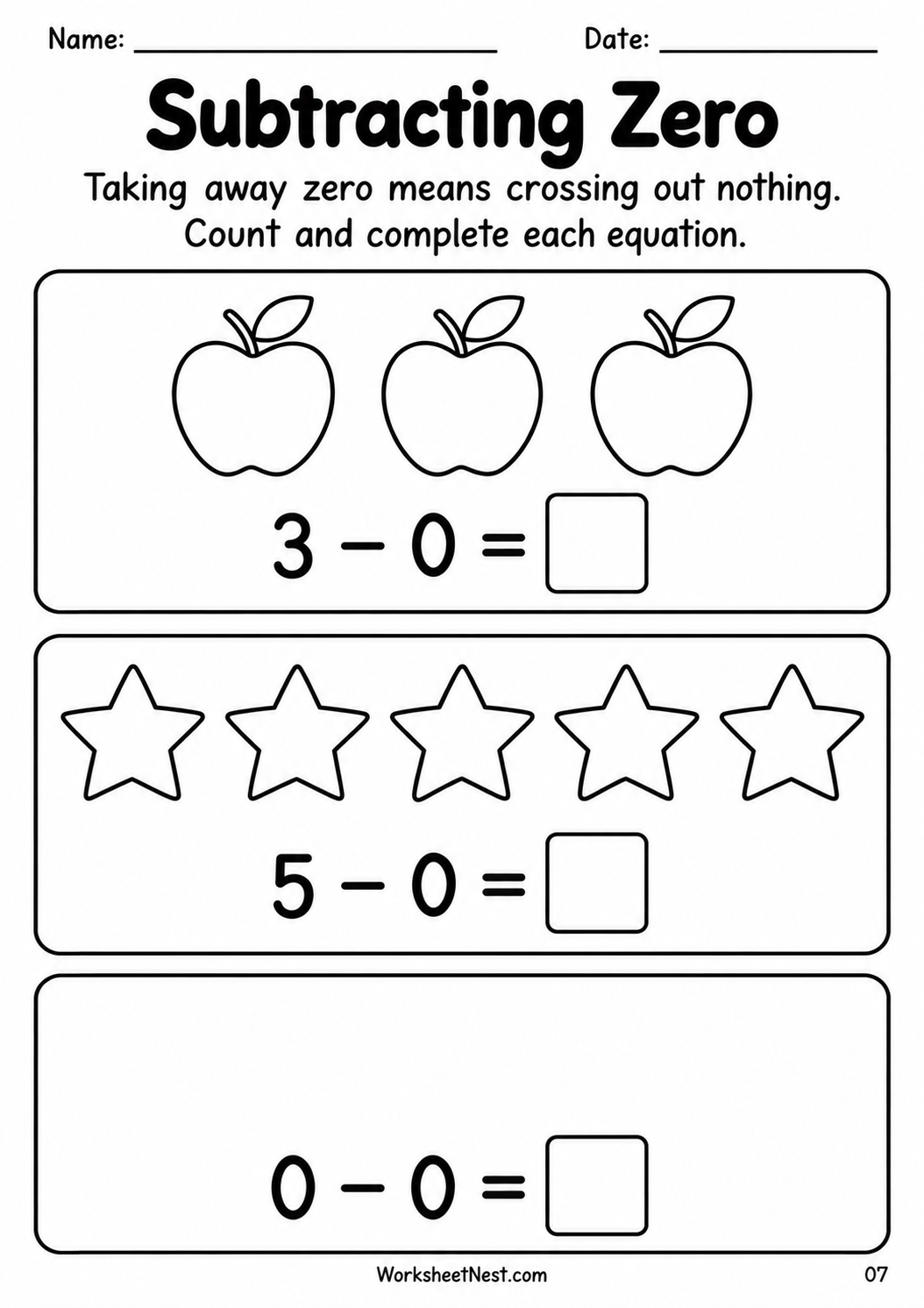
Taking away zero means crossing out nothing. Children use a group of three apples, a group of five stars and an empty picture box to complete 3 − 0, 5 − 0 and 0 − 0. Ask what changed in each group. Give learners time to explain that no objects were removed, including when the starting group was already empty.
08 — Take Away All
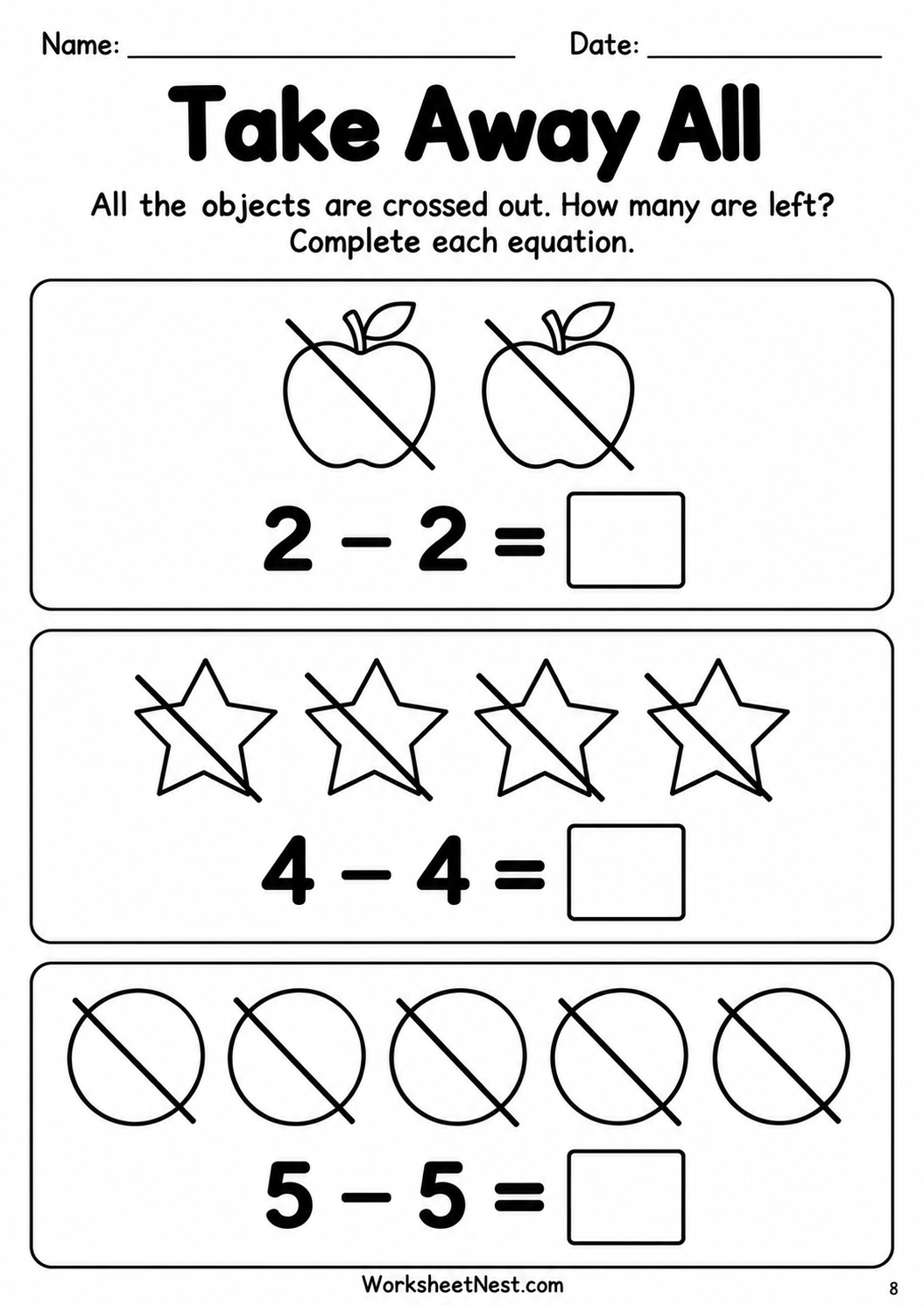
All the pictured objects are crossed out. Children complete 2 − 2, 4 − 4 and 5 − 5 after looking at apples, stars and circles. Ask learners to describe what remains rather than simply count the original group. The page offers repeated practice with zero as the result when every object in a group has been taken away.
09 — Picture Subtraction Stories
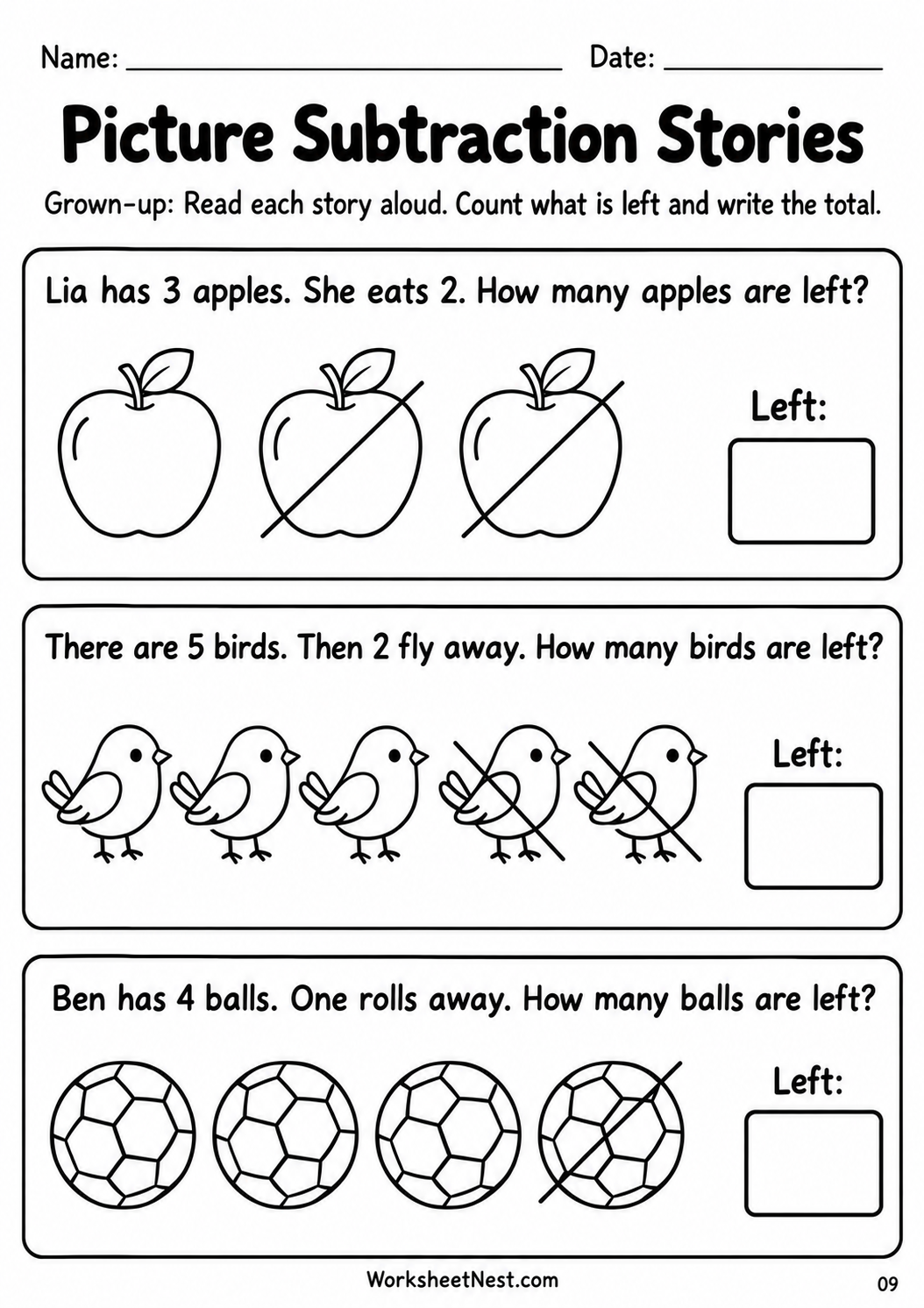
A grown-up reads each short story aloud. Lia has three apples and eats two; two of five birds fly away; one of Ben’s four balls rolls away. The corresponding pictures show the objects removed, and children write how many remain. Retell one story with small counters if needed, then return to the picture and connect the story’s action with its crossing-out marks.
10 — Subtraction Within 5 Review
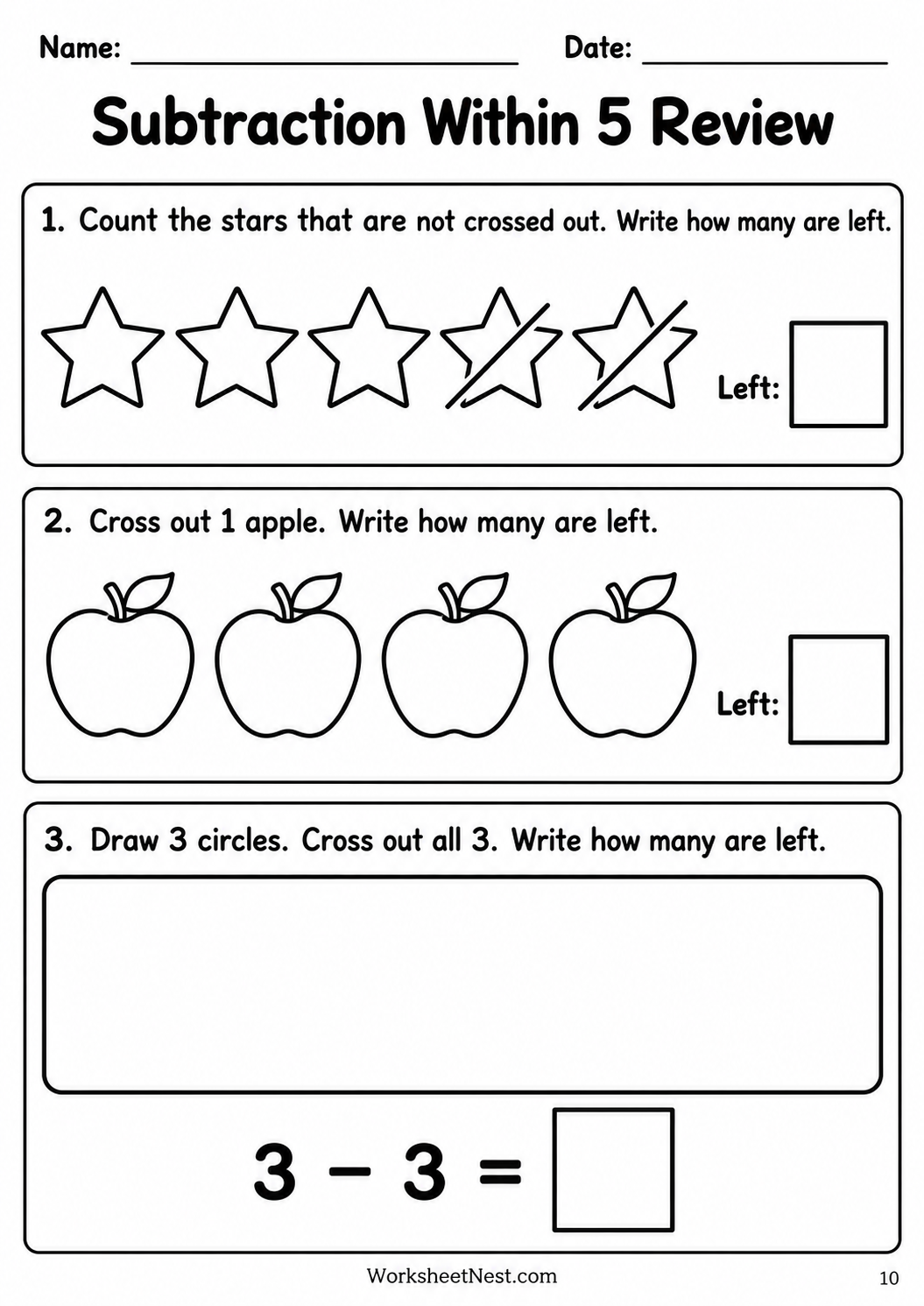
The review combines three ways to show subtraction. Children count stars that are not crossed out, cross out one of four apples and write the remaining total, then draw three circles and cross out all three for 3 − 3. Watch which step the child handles independently. Their work can help you choose an earlier page to revisit without making the review feel like a timed test.
Full Picture Subtraction Within 5 Worksheets Bundle
The collection brings together 11 pages: one colorful cover and ten black-and-white activity pages. The bundle follows the same activity order shown above. Choose individual pages for focused practice, or keep the set together to revisit counting, crossing out, drawing, five frames, zero and simple picture stories.
Download the Full Picture Subtraction Within 5 Bundle
Teaching Ideas
Before using a worksheet, make a group of up to five safe classroom counters. Move some aside and ask, “How many are left?” Connect that action with the crossing-out marks on the page. Let children point, move counters or explain aloud before writing an answer. If a child counts crossed-out objects, revisit the meaning of “left” with a small concrete example.
Use one page at a time and stop when attention fades. Matching pages can reduce handwriting demands; drawing pages give learners a chance to build a model themselves. Read the story page aloud so decoding does not become an extra requirement. Invite children to explain how they found an answer without requiring one particular spoken sentence.
For background on this approach, the DREME guide from Stanford University explains that subtraction involves taking some objects away from a set and then counting what is left.
Printing
The supplied PDFs use A4 portrait pages. Preview the selected file before printing and choose a setting that preserves the whole page. Check any automatic paper-size conversion when using US Letter paper. Interior activities are black and white; print the colorful cover only if useful. Use a clear test print to check that crossing-out marks, frame lines and answer boxes remain easy to see.
Common Core Connections
These activities offer partial practice toward the following Common Core State Standards (Kindergarten) skills.
K.OA.A.1: Children represent subtraction with objects, drawings, and pictures. Pages 01 to 08 and page 10 ask children to count the objects that are not crossed out, match what is left to a numeral, complete picture equations, draw and cross out circles, and count counters in five frames.
K.OA.A.2: Page 09, Picture Subtraction Stories, is the only page that presents subtraction word problems. Short stories are read aloud, pictures show objects being taken away, and children solve each story within 10 using objects or drawings.
This is partial practice only, not full alignment with either standard, and the word-problem claim applies to page 09 alone.
License and Terms of Use
Free for personal, homeschool, and classroom use. Printing and link-sharing are allowed. Selling, re-uploading, or redistributing these worksheets is not permitted.
Explore More Learning Activities
Subtraction Worksheets Math Worksheets